Tuesday, August 19, 2014

On "Children of the World" and Short-Term Missons

So, those of you who are facebook friends may ave seen me bemoaning the misunderstood nature of charities like the Children of the World choir and the role of youth group missions trips. So, in an attempt to clarify where I stand once and for all, I give you my explanation:

On missions trips, I feel that their main role is to help missionaries to meet a task they would otherwise be unable to, due either to a lack of necessary skills or manpower. Examples of this would be disaster relief, healthcare trips, church building, or surveying. Conversely, what I see happening often, especially with youth trips, is that there is not much of a need that is met. Yes, there is exposure and growth from the team's side as they see and experience the great commission and there is community built between the local church and the sending church, but there is often little true progress or achievement and it can end up draining for the receiving missionaries. 

A good example of a large team of students being put to good work is from about 6 years ago, when a professor from Southeastern, took some students to do evangelism work. As part of the trip, they did some surveying, some work with local churches, and they cleared a field. This field, you see, belonged to a school some of my parents' colleagues were trying to start a program with. Normally, it would have taken a month or more to clear the rocks from it and make it usable, but these students did it in a day. As a result, the school allowed the missionaries to run their after school program. 

So, as far as youth trips and other trips go, they have good use and purpose, but they need to be done well and not foster a poor first world - third world perception, which is my second point.

My beef with the Children of the World choir (and other projects like it) is that is exploits the third world and presents a false representation of these nations and cultures. Every time I see them perform, I am reminded of a song by Johnny Clegg, titled "Third World Child," in which the chorus goes:
"Learn to speak a little bit of English | Don't be scared of the suit and tie | Learn to walk in the dreams of the foreigners | I am a third world child."
I know that many of these charity projects do good work. CotW provides good education and quality of life for these kids and brings awareness of people in other countries. The negative is the way that awareness is presented and processed. To me, it looks like the image presented is that they've taken these kids from a poor environment, clothed them, taught them, and are now showing them off. There's no celebration of the individual cultures; it's all homogenised into the American Church experience. The image portrayed, then, is that we, the first world, need to go into the "dark," "lost" third world and give them what they need to be like us, that we need to intervene. What is needed isn't intervention, but investment. We need to send skilled, trained individuals from the first world to train those in the third world in necessary, marketable skills: digging well, building houses, farming, pastoring, etc. In doing so, we encourage self-reliance and foster growth of the local GDP, enabling it to develop, while not forcing an American perspective or ideal overtop the ideals, flavors and actual needs of the particular culture. 

A classic example is Haiti - when the disaster struck, we responded correctly, providing needs. However, we've stayed way too long. It's been a number of years since the earthquake and we're still going and giving supplies. Why? Well, we see that everyone's still poor and needy, but the issue is that they're still poor and needy because there's no incentive to change. After all, the US is always sending people with stuff they need.

So, in a nutshell, my biggest grievance is the objectification of the third world and the reaction thereunto. Second is the manner in which youth missions trips, while beneficial to the team members, often do not benefit long-term either the missionaries or locals.

Thursday, July 31, 2014

Gaming for Jesus


So, as Christians, we've all heard the encouragement to "do everything as unto the Lord." Usually it's in some context of "always give your best." Well, I'm beginning to come to the realization that it means something a bit more. While the motivational encouragement to go above and beyond the call of duty is well and good, I've begun to see that the emphasis might not necessarily be on the "as unto," but on the "everything."

Where did this realization come from?

Well, I'm a gamer (big shock to those who know me) I play everything from card games to board games and video games to tabletop games. Yes, I play D&D, Munchkin, Pathfinder, Catan, Poker, Risk, Chess, Neverwinter, DDO, Fable, Uno, and the list goes on. The only exception, really, is Monopoly. Never again will I play such a tedious, soul-sucking game, but I digress.

Usually the idea of gaming for Jesus revolves around being polite, not swearing, or not making lewd jokes while in game chat; playing as only good characters (or, if you're a bit more of a Fundamentalist, only Lawful Good); or being part of a Christian guild in which, I would guess and stereotype, the general stream of conversation would include prayer requests (good), smiting evil in the name of the Lord (really?), and the Holy Hand Grenade of Antioch (I wish). I think we can all agree that these are all good things to do, but they're all a bit stunted. Heck, I used to fall into that camp. I usually only play good characters (or at least abide by the in-game law) and I've acted as guild chat mediator/policeman on many occasions.

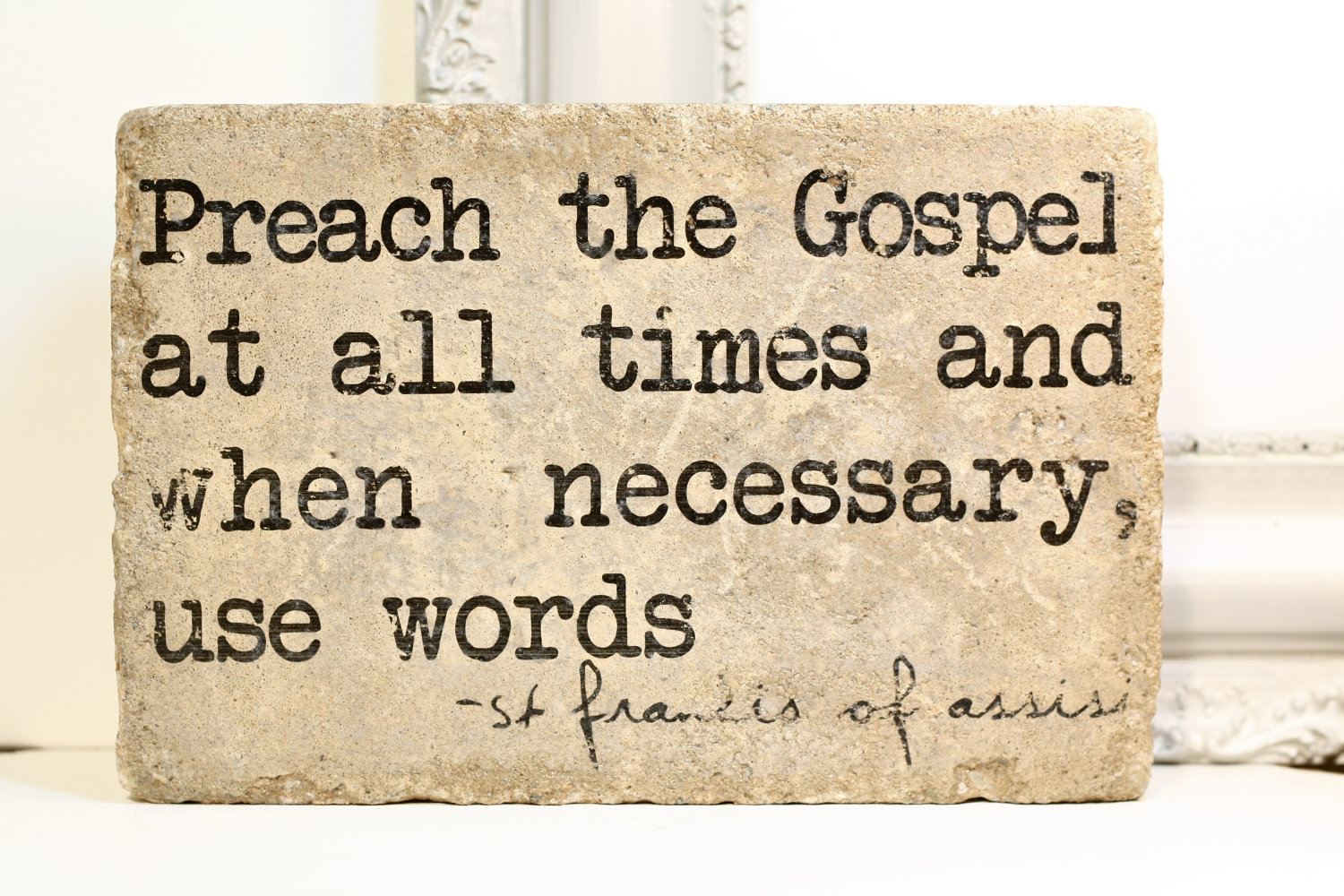
Where do all these ideas stem from? Well, there's a popular tenet in Western Christian culture spoken by a long-dead man from a little place called Assisi.
Now, there's nothing wrong with this quote. It's a very good quote, but as I've said before (perhaps not on this site) what's the difference, outwardly, between a Christian and a really good, moral person?

See, we live in a society of very good, moral people who believe that they just need to be good enough and God or the "great, mysterious, benevolent power/s that be" will let them pass into paradise. Christianity has been maligned and rubbed into the dirt through tabloid-esque fallings-out between pastors and churches, or pastors and their wives. Christianity is misportrayed as hypocritical or an impossibly high standard upon which everyone involved is then condemned for following it or failing in their attempt to do so.

Understandably, many Christians have fallen silent, rather than speak up and show the difference, but that's the whole point of this quote. Back to my first question, what is the outward difference between a Christian and a good, moral person? 

Well, nothing.

The difference is inward. It's in the quality of difference, the consistency of difference. Te reason for the difference is, of course, that the BIG POINT of Christianity is that we're all screwed up, but are being changed from the inside. A moral person may or may not believe that man is screwed up, but the changes applied are external, because we, being screwed up, are incapable of changing ourselves. We need the work of an ultimately perfect God to perform the change. For St. Francis' quote to have any truth or merit, then,. one must already be walking around as a known Christian.

So, what prompted this change in perception about doing everything as unto God? Well, it was a simple conversation in whisperchat (in-game direct person-to-person chat instead of the common guild chat) in which one player who'd deemed me trustworthy began talking to me about life and struggles. The struggles just happened to be something that I couldn't explain the solution without God. I'd tried and the point didn't seem to be conveyed, so I broke my typical undercover Christian guise, outed myself and said the "G" word. It was then that I realised that it was possible to have a "redemptive purpose" for every different like and dislike. I can talk shop with my fellow scientists, musos, gamers, and guildies. I can build important relationships and model good, Christian living, but I can also use those relationships as vehicles for the Gospel. I can stand openly in my fields of interest as a Christian. I can share the Gospel without being cheesy. I can be attentive and listen to my fellows for what they need and, tactfully, tastefully, show them how God meets that need.

That, friends, is the merit of St. Francis' quote.

When a Good Movie Misses an Opportunity

So, a couple of days ago, I had the opportunity to watch Blended for the first time - excellent movie. I thoroughly enjoyed the humour, the story and how it went about handling the issue of blending two families.

You see, it focuses around two families who've lost a parent - one through divorce and one through cancer - and, frankly, it does a very good job showing some of the struggles of the parents and kids adjusting to the difficulties that come with both. It doesn't make light of any of the situations, but handles them with respect, showing and treating them fairly, while maintaining a casual, funny atmosphere. There was just one thing that was mishandled, though.

One issue brought up in the movie is that Drew Barrymore's character's older son (~13 y.o.) has been discovered to be viewing porn and has apparently been deep into it long enough to be superimposing crushes onto the magazines he's reading. When she first discovers it, she freaks, tearing up the centrefold, but later we see her apologetically looking through the magazine section of a drug store for a replacement. Throughout the movie the other characters' issues are shown and resolved, but for this character, his issue with what manhood means is addressed, but never the porn. Throughout the movie it's played off with sideways jokes, nudges, and winks. It's treated as just a normal part of a boy's life, with Sandler's character even admitting to having a couple copies himself and commenting to Barrymore on her son's "old school" tastes.

Yes, we see some of the effects of porn played out in the kid's role, chiefly a stunted ability to interact with women beyond simply as vessels for lust,but never do we see an admonishment from Sandler's character in a fatherly role towards pornography or its effects. Now, I know it's not a religious movie, but you don't have to be religious to see some of the exploitative work and trafficking that is enabled by the porn industry.

It's good to see such an issue brought out into the open on the silver screen. I just wish the producers had done a better job addressing it.

Thursday, June 5, 2014

For Our Sons

I'm only a young man. I haven't seen much in my meagre 23 years. I haven't experienced or done much, either, but this is something that I'm beginning to understand the gravity and magnitude of that I think needs to be better understood by men at large.

Previously, I've clumsily typed my way around the red-herring modesty debate (I'm not going to link it, but it's somewhere here on this site), thinking that was a good approach to take, to chip in my two cents that men need to be proactive and work to prevent what many merely tell women to react to, that is, lust. Equally clumsily, I've spoken with friends who are feminists, trying to ascertain their positions (didn't quite get it, but hey, I was trying, right? [wrong attitude]).

I finally got around to looking at the #YesAllWomen making its rounds. It took me a while, because I'd dismissed it as "just another feminist outrage," but what caught my eye was that men I know whom I have never seen post anything feminist were sharing it, posting it. So, I gave it a look. To me, it was nothing flooring, but it piqued my interest. I did a bit of searching for articles about the movement, read a few of the latest twitter feed posts and realized something crucial - I don't understand.

I don't understand why my sister had to wait until she was older and still take a dog with her to go running, whereas I could've gone on my own whenever.
I don't understand the pressures of the media on women to look beautiful; after all, men's health puts the same standard on us men, right?
I don't understand why women don't feel comfortable walking to the shop after dark for a few quick necessities.
I don't understand why women have to say they have a boyfriend/fiance/spouse for their "no" to be heard.
Just to name a few.

Let me flip this scenario on its head:
Men, you are now the physically weaker sex. Society has relegated your role (traditionally) to cooking, cleaning, and minding the home. Some concessions have been made, however, and you can find work, though you might not be paid equally and you might be discriminated against. In fact, you might be hit on, harassed, or sexually assaulted by someone of the opposite sex who, being stronger than you physically and in the unwritten perception of society, is able to take their way with you, leave you, and still, no-one will fully believe you, stating that you were "asking for it" because of how you were dressed, had led the person on, hadn't said "no," etc.. You face pressure from part of society to change the way you act and dress because you're "making them lust." Conversely, you face pressure from the media and the market to fit an ideal of beauty because, let's face it, regardless of how smart or strong you are, everybody's only truly going to regard you based on how pretty you are; the applicable attributes only begin applying secondarily.

Swap shoes for a moment. Can you truly say "I don't understand" any longer? How about if I told you that the originator of #YesAllWomen is being bullied and pressured by the internet community, or that #YesAllWomenJokes has been made and is making its rounds. Can you not see the discrimination riding on the unwritten undercurrents of Western society?

I send my appreciation to the authors of #AllMenCan and #EachEveryWoman as they seek to keep this discussion on the table.

I'm only a young man. I haven't seen much in my meagre 23 years. I haven't experienced or done much either, but as I grow and (hopefully) become a father, I will teach my sons this message. Will you teach yours?

Sunday, May 25, 2014

A Systematic Exposition of Salvation

It has occurred to me that while I may speak of or reference different aspects of salvation, I have not actually put to writing a systematic discourse on my beliefs and reasonings relating to salvation. Therefore, this post has been written. Take from it what you will. If you are here to deride, scorn or belittle, I bid you good day. If you are here out of curiosity or a search for understanding, welcome!

At the beginning is God, omnipotent, omnipresent, omniscient, and omnibenevolent, who, merely with his speech, brought forth into existence time and space, giving everything form and functon for the express purpose of displaying His attributes, an action which, in any other being would be blasphemous and arrogant, but, as God is the supreme being, there is none higher for Him to give service to, making it, therefore, reasonable for God to act towards his glory, spurring the creation of time, space, the details, and man, the pinnacle of His creation, who was imbued with the ability to glorify God in the freest, fullest of manners: by free will, a gift which, at the moment of testing, was used to choose disobedience over obedience, marring the perfection of God's creation, separating mankind from God, because God, being infinitely perfect, righteous, and holy, cannot, by His nature, bear the presence of our then newfound imperfection, but instead, acting out of time, ended the scourge of disobedience at a set point in time foreknown to give Him the most glory, while, acting out of mercy, love, and grace for His creation, inside the flow of time, providing a temporary means of expiation of this disobedience, this imperfection, this sin, through the lifeblood sacrifice of a pure, unblemished animal, setting the stage for the future, permanent atonement for the fallenness of His creation, which occurred through the sending of Jesus, the son of God, who, being fully God, yet fully man was able to identify with and understand the burdens and cares of man, yet was able to live a life pure and without sin, providing a lifeblood sacrifice in accordance with the law set in time previously, the difference being that Jesus, being fully God, is not temporal, is not finite, but, rather, is infinite, able to atone for the sins of humanity past, present, and future and, after his death, was buried, but, three days later, He was returned to life, thereby breaking the necessary consequence of sin, that is, death, as the final part of His sacrifice such that whosoever accepts this sacrifice has his or her sins paid for by the sacrifice of Jesus such that under the eyes of God, it is as if he/she has never sinned, allowing him/her to be rejoined in communion and relationship with God.

Thus ends my expounding of the justifying action of salvation in one sentence.

Sunday, March 30, 2014

13 Signs that You Need Restoration

So, credit goes to my pastor for these, but they really stood out as gems, so I wanted to share them with you.


  1. Prayer is no longer a vital part of one's life
  2. Questing [his word, not mine] for Biblical truth has fallen by the wayside
  3. Biblical knowledge is possessed but no inwardly applied
  4. Pleasure becomes a necessary, compelling factor
  5. Gain dominates one's thinking
  6. Hymns and words are mouthed without any heart
  7. One finds oneself watching and reading morally corrupt content
  8. Breaches in one's church bring no concern
  9. The slightest excuse is sufficient to keep one from one's duty
  10. One is content with the lack of power and fillings of the Holy Spirit
  11. The music in one's soul and heart is no longer present
  12. One is gladly adjusting one's lifestyle to that of the world
  13. The tears have run dry and conviction of sin is absent

If, while reading this, you find yourself moved inwardly, saying, "that's me," then I encourage you to take some time, now, and drop to your knees, praying and asking God for a renewal of spirit, for the restoration that He brings, so that, once again, or for the first time, your heart might be moved to the passions and urgings of a God who loves us deeply and intimately, yet who also is a God of perfect standard that cannot be obtained and met by our feeble, dirtied attempts at perfection, but who, in a display of His mercy and grace, paid the debt of perfection and the punishment of its failure in a manner consistent with His law by providing a sacrifice sufficient to pay such an infinite debt through the sending of his son, Jesus, the Messiah, who, being fully God and fully man, lived a life of sinless perfection, endured the mockery of his peers and countryfolk, the ignominy of torture and death, the weight of eternity's sin and punishment, and the rejection of God, his Father, for the sin he carried and yet, having paid in full the price of sin for all mankind, he rose from the dead, breaking the chain of sin and death and has since risen to the Father's side, where he presents our cases on our behalf and prepares a place at the Father's table for those who, seeing they cannot ever pay their debt in full and are thus deserving of the punishment given for sin, have turned in faith to him, accepting his sacrifice, and committing their lives to following him.

(Yes, that's one grammatically correct sentence)

Wednesday, March 12, 2014

Twisted Mirrors: Lust

Lust is something not very well defined today in the church. This is possibly because it is one of the largest skeletons in almost everyone's closets. Very few want to talk about it and, if they do, even fewer are candid.

The basic definitions that I have found portray lust as wanting something or someone you don't and might not be meant to have [1] or, from a more Augustinian perspective, the perversion of love. While the former is valid, it is not fully complete; the latter is closer to the mark, but only if a very complex, manifold view of love, its attributes, and attitudes is applied.

For simplicity's sake, I shall write from a perspective that, to me, is equally close to the mark, if not closer: lust is the perversion of desire.

Desire is not evil, not in its original intention. Desire seeks something to satisfy it, to appease it. Ideally, this should direct us to God or the God-given fulfillment of that desire. Classically, lust is defined as misplaced or perverted sexual desire, the desire for objects in general and for others' possessions and situations, being greed and envy, respectively.

How, then, does lust play its hand? It presents itself as a temptation, a counter-offer to God's provision for a particular need. In this context, the need could be one for some sort of intimacy, whether it be emotional, physical, relational, etc.. Lust presents itself and its subsequent actions as a source of satisfaction, but being mere perversion of God's provision, it cannot properly fulfill said need.

Lust offers a temporary, hollow, cheap alternative to the proper meeting of our desires. as a result, we can find ourselves delving ever deeper into its offerings as we seek for better fulfillment. In doing so, we condition our hearts and minds to turn to lust's offerings first, becoming addicted as does an alcoholic or a narcotic. Why? Because it provides a thrill, a temporary meeting of a desire for little cost, we continue to seek it out, becoming ever entrenched in its workings.

We're dealing not just with sin, but addiction and, unfortunately, the substance for this addiction is all around us. Advertisements, billboard, magazine, television, or otherwise, provide plentiful source material for the satiation of lust in some degree. Fashion, too, can play a part. So can the media through film, books, and even the radio. Sex sells and, unfortunately, it sells well.

So, if lust's source material is all around us, how does it take place? How does it offer its wares for the individual's "satisfaction"? Visually/mentally and physically.

Visually/Mentally

  • Ogling - the visual stripping down of a woman for some degree of sexual power or satisfaction. It is the perversion of appreciation and admiration, both of which, in their pure, intended roles seek to praise God for the beauty of His creation.
  • Pornography - the seeking of sexual satisfaction from media. This can be in the form of single images, film, or written text. This also does not have to be depictions of sex and/or nudity. It varies depending on the individual; for one, just the image of a woman in a scoop-necked top could be porn as it incites lust and the temptation to then seek satisfaction therefrom. It is the perversion of the desire for sex with one's own spouse in addition to the perversion of the appreciation and admiration which is to be reserved for said spouse.
  • Replay/Fantasizing - the mental recall or projection of a particular image or individual that incited lust. This can be intentional or unintentional, but it is more than simply the image popping into one's head, but rather, the dwelling or expounding upon said thought. This is a perversion of the regard with which one thinks about another, particularly the way one should think about one's spouse only.
Physically
  • Masturbation - the seeking of the gratification of physical sexual desire by oneself. Straight up, it is a perversion of the desire given to us which should be for our spouse only in addition to the perversion of the form intended for said gratification. Single or unmarried individuals, sorry, but the only proper gratification for this desire is to wait patiently for your spouse.
  • Adultery - the seeking of physical sexual gratification with one not one's spouse. Again, the perversion is fairly clear, it is the twisting of what was meant to remain in the confines of a marriage with one's spouse.
As we can see, lust has many faces, some of which may even seem innocuous, but what happens is that one addicted to lust finds oneself completely lacking satisfaction from that which should fulfill it. Relationships, particularly those with one's spouse and with God become cheapened [2], [3]. It is an issue of the heart, then, of the very core of our being.

How, then, can we overcome lust? Not by our own strength. Convicted of what I had read thus far, I sought to stay pure from lust during my shift at work. The number of times I was tempted to simply ogle an ad, coworker, or customer was surprising, not to mention the number of times a thought from my previous foolishnesses tried to bring itself to the fore. I quickly became convinced, in a more-than-head-knowledge kind of way of the necessity for God's intervention. Sure, I could have kept it up myself, but the strain from just 5 hours was immense. I'm under no illusions that I would have burnt out within a couple of days at best.

We need to become broken. That's Christianese for "We need to realize our helplessness in the face of our sin, discard any last vestige of pride, and humbly come to God in genuine desire for freedom." It is, after all, a hear issue. We need to come, asking for God to restore our hearts to their proper orientation - towards Him. We need to desire God above the false satisfactions of lust. Only then will the war begin to turn. Unfortunately, we cannot change our hearts. We have the unfortunate predilection for sin, the disobedience and turning away from God. It is ONLY through God that we can even be able to come to Him, to obey Him, to truly desire and give glory to Him.

Why, then, do we persist in the illusion that lust and its faces are simply our personal issues, never to be shared with anyone? Why do we enslave ourselves to empty fulfillments and addictions. Let us instead cry out to God. Let us reach out to one another and hold each other accountable for our addictions and trials.

I am human. I lust. I want out.

(For more on lust and overcoming it, check the links cited in the post above as well as these, too: [4], [5], [6], [7], and [8])