Showing posts with label South Africa. Show all posts

Thursday, December 1, 2016

First AID(S)

Dec 1 is a day set aside globally to recognise an ongoing fight in public health. This fight, unfortunately, is often overlooked in the US, despite a large number of sufferers - after all, there's a solution and it's well-managed, right?
Not quite.

True, antiretroviral therapy (ART) is available to combat HIV/AIDS, but it's no silver bullet. No these drugs, at best, keep the virus in stasis (provided the drugs are taken like clockwork) and bring a host of negative side effects to the patients.

Did I mention that these drugs meed to be taken for the rest of one's life and that they aren't always cheap? Right, fancy that.

To put that in more perspective, though, let me run you by some statistics:
  • In the US
    • > 1.2 million individuals are living with HIV
    • ~39 500 individuals were newly-diagnosed in 2015
      • 67% were gay & bisexual men
        • 82% of all male diagnoses
      • 24% attributed to heterosexual contact
      • 6% attributed to injection drug use
    • African-Americans are 13% of the population, but represented ~ 45% of new diagnoses
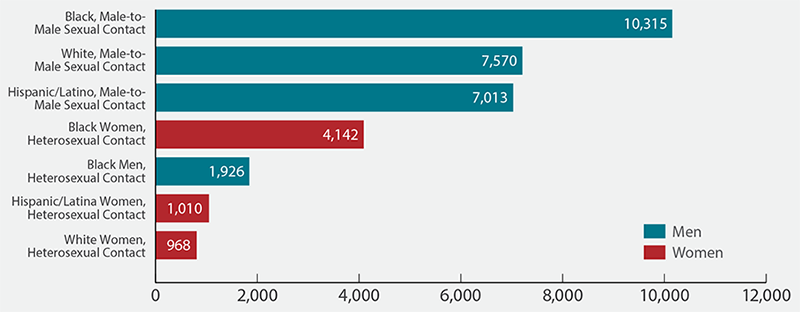
New HIV Diagnoses in the United States for the Most-Affected Subpopulations, 2015
    • ~ 13 000 passed away from AIDS-related complications
    • Approximately 37% are on ARTs
  • In Sub-Saharan Africa
    • Approximately 24.7 million people are living with HIV
    • In 2014, there were 1.5 million new infections
    • Roughly 1.1 million individuals died from HIV/AIDS complications in 2014
    • Only 39% of individuals are on ARTs
    • South Africa, where I grew up, has a 19.2% prevalence of HIV in the adult population
      • Only 48% of those are currently receiving ARTs
      • South Africa has the biggest HIV epidemic of any country in the world
  • In Asia and the Pacific
    • Roughly 5.1 million are living with HIV
    • 300 000 were newly diagnosed in 2014
    • 180 000 passed away in 2014
    • 41% are on ARTs
  • In the Middle East and North Africa
    • 230 000 people are living with HIV
    • There were 21 000 new infections in 2014
    • There were 12 000 new deaths in 2014
    • Only 17% are on ARTs

  • In Latin America
    • 1.6 million are living with HIV
    • 94 000 are newly-infected as of 2014
    • 47 000 have passed away in 2014
    • 44% are on ARTs
  • In the Caribbean
    • 250 000 are living with HIV
    • 12 000 were newly-infected as of 2014
    • 11 000 had passed away
    • 42% are on ARTs
  • In Eastern Europe and Central Asia
    • 1.5 million were living with HIV in 2014
    • There were 190 000 new infections
    • 47 000 passed away from HIV/AIDS complications
    • 21% were on ARTs
  • In Western and Central Europe
    • Approximately 1.2 million are living with HIV
    • Approximately 50 000 were new infections
    • Approximately 9000 passed away
    • 59% are on ARTs

So, now that you're just a slight bit more aware of the global AIDS crisis, please, get involved. There are a myriad of organisations committed to HIV/AIDS research and awareness, including the NIH, amfAR, UNAIDS, (Red) campaign, One, and more.

Maybe supporting an AIDS orphanage is more up your alley. If so, Beautiful Gate is one I know of personally, but there are many similar organisations around the world.

The point is, please, speak up, get tested, fight the stigma, and, most importantly, campaign for a cure.

Sources
  • https://www.aids.gov/hiv-aids-basics/hiv-aids-101/statistics/
  • http://www.avert.org/global-hiv-and-aids-statistics

Friday, November 11, 2016

11/11

Today is of twofold value to me. In the US, it's Veterans' Day. Overseas, it's Remembrance Day or Armistice Day.

(Memorial Day, in the US, is on the anniversary of the end of the Civil War and has been a holiday here, obviously, longer than Remembrance/Armistice Day has been in the rest of the world)

To my friends, family, and colleagues in the US:

For those of you who have served, thank you. Whether in the Army, Navy, Air Force, Marines, or Coast Guard, whether based abroad or at home, whether in combat or out of combat, you have risked and given much in the defense of this country and the ideals it holds dear.

For that, you will always have my thanks and appreciation.

To my friends and former colleagues overseas:

Today, we remember those who paid the ultimate price. WWI and WWII exacted an extreme toll on many countries and many communities around the world. Of course, these are not the only wars waged on a global scale. Immediately coming to mind are the Vietnam war and Korean conflict. These men and women gave their lives to pursue and protect the ideals we hold dear in our modern, Western age.

From the rising of the sun to the setting of the same, we will remember.

Wednesday, September 21, 2016

Forest and Trees

Today, I want to speak to my fellow white people, particularly my fellow Christian white people.

Many of us are missing the point

Yesterday, an innocent man, Terence Crutcher, was shot. He was an innocent man inspecting his own car. He was tazed and shot because he did not immediately follow instructions. He was unarmed. He had his hands up and visible. Now, investigations are ongoing and this article has a fairly good summary of the due process that needs to be followed and the confounding legal questions, but the shooting is not what I want to highlight.

I want to highlight our response.

You see, Mr Crutcher is a black man and, unfortunately, he is now the newest name in a growing list of black men killed by police. He is now the next name on a list in the argument against police brutality and social injustice. You would think that, after such a tragedy, there would be mourning as a community in response. No, no. I only heard about the shooting via my wife. I saw nothing from any of my white friends except a post which showed how there are good relationships between black men and police.

Yesterday, in Langa, a peri-urban settlement (lit. a shack town) in Cape Town, South Africa, inhabited almost completely by poor black individuals, was in the midst of a protest against poor services delivery. The only word I heard from any of my SA friends was from one person who had to drive through the protest, recounting the shock of riot police, guns, and the smoke of burning tires, praising God and thanking the police that she made it through safely. My fellow white people, I am ashamed. You are focusing on the minutiae, the trees, when the problem is with the forest.

The protest of police vs black violence is not about shaming the police. It doesn't require you to defend the police or discredit the victim and find opposing evidence - there will always be evidence to oppose anything, provided the inclination is there. The issue is about respect and fair treatment under the law, something assumed by many of us white people, but still being fought for by many of our fellow black men and women.

Service delivery protests/riots, while terrifying, are happening because of a real problem. While we recount the horrors and fears experienced as an outsider passing through, let us remember that what many white people have and take for granted, our black brothers and sisters are fighting to obtain - and not because they cannot afford it, but because it has yet to be delivered.

Just because we, as white people, are not immediately impacted is not a sufficient excuse to dismiss the injustice surrounding us in society. When Christ gave the parable of the good Samaritan, he did not say that our neighbour extended only to those who looked/spoke/thought like us. No, the whole point of the parable is that loving our neighbour means seeing the hurt, the maligned, the needy, and doing what we can to help.

And that help? I'm not advocating at all for the White Messiah complex. For help to be actual help, it must be the right type of assistance/aid/support, given in the right manner, at the right time. To make a comparison, if someone drops on the floor, having a heart attack, you don't begin scolding the individual for any habit he/she might have that contributed to his heart attack; you administer CPR or find someone who can. When social injustice is shown, you don't tell the victims they're imagining things or that they've contributed to their own issues; you stop and listen, giving a willing ear and a heart willing to understand, and, should the opportunity present, take some measure of appropriate action.

Are we not called to weep with those who weep and mourn with those who mourn? What would it hurt to take a moment to empathise - to place ourselves, our families in these repeated cycles of injustice? Would it hurt to turn to a black friend, relative, or colleague and simply say, "I heard about what happened. I'm so sorry."? Take the initiative. Put yourself out there in love, seeking to understand or support. Make that connection. If nothing else, it's a start.

Friday, June 17, 2016

A Church Divided

So, I was reading through Paul's first recorded letter to the Corinthian church (In truth, if I recall correctly, it is the second of four, though we only have records for the two we call 1 and 2 Corinthians) and partway through the first chapter, Paul begins addressing some rivalries and divisions happening within the church.

He rebuked them, calling them to ponder three questions:

  • Is Christ divided?
  • Was it Paul who was crucified for you?
  • Were you baptised in Paul's name?
As I was looking over this passage, what came to mind first were some of the church splits I have seen, with individuals falling out between leaders or over minor details, thinking along the lines of "Did Pastor X die for you?" or "Were you baptised in the name of Deacon Y?"

The more I pondered it, though, the more I realised that the divisions within the church run far deeper than merely within an individual church. Many divisions today run along doctrinal or interpretational lines. Methodists vs Baptists, Orthodox vs Catholics (or Protestants/Anglicans vs Catholics for that matter). The church today is massively divided. Now, yes, there are some divisions along lines of preference. Those preferring a more ordered service may sit comfortably within a Presbyterian church than an Assembly of God. That being said, there are divisions along racial lines, political lines, policy lines. We have divided ourselves over minutiae.

In light of this passage, I am inclined to agree with Erasmus where he butted heads with Luther, wanting to bring about change within the Catholic church instead of fracturing and starting a separate church.

Yes, we are going to have differences of interpretation of scripture. For example, when it comes to the end times, my pastor ascribes more to the dispensational philosophy/theology whereas I fall into a post-tribulational premilennial standpoint. Does that mean I should leave my church? No.

Baptists, did the Anabaptists and early baptists die for your salvation? No.
Methodists, were you baptised in the name of John Wesley? No

Catholics, was Leo IX crucified for your salvation? No
Orthodox churchgoers, were you baptised in the name of Cerularius? No

We all were saved by the crucifixion and resurrection of Christ. We were all baptised in the name of Christ.

Let me ask you, is Christ divided?

Then why do we, the church, divide ourselves?

Should we not focus on Christ as the unifying goal? Should not our doctrines be subject to Christ and should we not be able to come together under the banner of a single, catholic (not Catholic; it means "universal") church?

I mean, that was the purpose of creating the Apostles' Creed and the Nicene Creed, to establish what is common doctrine to all Christians, that we may focus on the forest instead of getting lost amongst the trees.

These are my thoughts, though. I am no theologian. I do not know the intricacies of the dividing points in different denominations' doctrines and I do not profess to know. I merely am asking a pertinent question.

Thursday, February 18, 2016

Erace

I want to take the time right now to speak on a serious topic that's been particularly heartbreaking for me.

Those of you who've been reading my blog for a while know I grew up in Cape Town and, while I may not currently live there, I have many connections back home and so, I see a large amount of what goes on and what some of the key issues are.

South Africa and the US have a good number of similarities, as far as social dynamics go. One such similarity that's been building in my awareness is the disparity of perception and treatment based on the perception of wealth and degree of whiteness.

And that grieves me.

At the University of Cape Town, a number of events have occurred within the past couple weeks. I won't pretend to know the full thought and intention, but they prompt me to see that many people, students especially, are fed up with the non-progress of social equality in SA.

In the US, I see the federal neglect of water quality in Flint, where ~ 63% of the population is non-white and 42% of the population is below the poverty line. I see awards ceremonies where black artists are awarded in an "urban" category, but don't even really place in the grand running, or where black actors and actresses are only recognised if they make movies and shows appealing to a broader (read: white) audience.

We still live in a society where one's degree of whiteness or affluence affords an individual certain subconscious benefits and, let's be honest, we judge affluence by adhering to a white standard of dress and decorum.

Here's where it hits home for me: my children will not be afforded the same generosity of subconscious treatment that I have received. They will be born into a society in which even a drop of melanin darker than an Italian or body features more akin to Africa than Europe are sufficient to unconsciously define them as "lesser".

For over 50 years in the US and over 20 years in SA, racial equality has been the law, but as many conservatives are quick to point out on issues like gun legislation: you can't legislate behaviour.

White America, white South Africa, open your eyes. Your brothers and sisters, your countrymen are overlooked, underrepresented, and unseen. 
When someone with a different background and a little more melanin than you moves into your neighbourhood, how do you respond? Do you act differently if they speak, act, and dress like you? 
What about a new hire at your work, do you assume that he earned the position if he's white, but was given a position to help "diversify" the company if he's hispanic, black, or another such marginalised group?  
How do you talk about other people groups? Are you "Us" and the others "Them"? 
How do you react when you see some white teenagers walking down the street compared to black teenagers?

Church, what about you? Look within your walls. How many different colours can you see?
Are you monoracial or diverse?
Do you have an even spread across racial lines or only a token few not of the majority?
Are you reaching across racial boundaries to show Christ's love?
Are you stepping out in faith where you might be uncomfortable to take on the plight of another?

Take a look at James 1:27. Need I remind you, Church, that we are all one people under Christ, as Paul makes clear that there is no division like Jew or Greek? Why, then, do we allow this disparity of treatment by race to persist? 

If these things are troubling you, maybe striking a chord, I urge you to read a couple posts (The Passion of the Chris & Sodomy: A South African Love Story) from a pastor friend, Brett "Fish" Anderson.

Now, all that said, here's the thing: I'm not much better.

I don't want you thinking that I'm giving all my money to the poor or that I go every weekend to the run-down parts of town to do some kind of charity work. I don't.

I don't want you thinking that I am that amazing white man who understands the entirety of the racial struggle and can serve as cultural translator for both parties. Ask my wife - I've earned the right to ask her her thoughts on the modern race dynamics and have come to the point that I recognise I don't understand. And that's okay, because I'm willing to put in the hard work to be humble and ask.

~ ~ ~

Some of you may be wondering why I'm targeting everything at the white population. After all, there is racism perpetrated by other groups and negative attitudes and behaviours from other sides as well. To put it simply, I am white. I have no right to dictate patterns of behaviour to those not like me, especially when people like me have contributed to the problems currently in place

Thursday, April 30, 2015

#RhodesMustFall, #Xenophobia, and #Baltimore

We're four months into 2015 and racial tensions are high.  Now, you American readers are probably very familiar with the Baltimore situation, but likely less familiar with the xenophobic attacks and outbreaks in South Africa and even less so the Rhodes situation.

Those of you who are familiar with all three are likely asking why I'm lumping them all together in one post. After all, they're in two separate countries; how much similarity can there be?

A lot.

South Africa and the USA share a common history. Both had colonial governments who endorsed slavery; both had racial freedom marred by state-instituted and -enforced segregation; and both are still experiencing backlash abd racial tensions regarding dissatisfaction with the lack of change since the establishment of equal rights and "true freedom".

#RhodesMustFall
Earlier this year, students at the University of Cape Town protested the presence of the statute of Cecil John Rhodes, South African governor under British colonialism, smearing the statue with filth and working towards its eventual removal. Rhodes was an effective governor, bringing much progress to the region, but he was also a product of the colonial mindset, which led to the protests that he was a racist abd led indirectly to the establishment of apartheid.

#Xenophobia
First cropping up in 2008, many black South Africans began raiding and looting small refugee-owned shops and businesses, as it was perceived that these foreigners were taking all their jobs. Earlier this year, those sentiments rose with added vengeance.

#Baltimore
Last week another young black man was shot and killed by a white policeman. In a case similar to #Ferguson, and #Trayvon, many African-Americans rose up to protest a fairly well established sentiment of unequal treatment and perception and, as in Ferguson, rioting broke out in the wake of otherwise peaceful protests.

All of these events are linked by common action and perception. We have violent protests and vandalism. We have members of the aggrieved party seeking peaceful protest and reconciliation, even going so far as to help repair damage abd protect the attacked, urging others to abandon the violence and seek true restitution through peace.

My thought as a white resident of both countries is this: these events keep occurring. They won't stop until we treat the root cause.

So, what's the root? Disempowerment of the black community. Unfortunately, it's less simple to treat than state. You see, part of the problem is caused by the state and non-blacks, but part of the problem is also caused by the black communities in both countries. In both countries there is a trend of self-victimisation and entitlement, the mentality that, as the previously disadvantaged, recompense is deserved. This is partial exacerbated by policies such as affirmative action and BEE. Such a mentality, in any population, also leads to a welfare state as individuals wait for what they deserve to be given to them instead of seizing the opportunity now granted to pursue actively what was previously unavailable.

Freedom, you see, is not about equal results, but opportunities and I realise that, as a straight, white male, the opportunities are a little easier for me to obtain and that is the true fault off the system, the true issue being protested, that when all animals are equal, some are still more equal than others. We can only combat this, however, through coming together across communities, meeting one another where we are, and talking about it.

That is my challenge to you, reader. Step outside of your community, your associations, and start a relationship with someone different from yourself, be they black, white, Hispanic, Arabic, or some other racial or social group. If you already do this, excellent, now encourage others to do the same.

Church, now is the time to act. We follow a teaching of equality under the same God, that regardless of background, we are all still sinners equally in need of grace. So, let us come together across boundaries and worship as one body, setting the example for others in reconciliation.

Update:
I have been informed Mr Gray posed away from injuries sustained while resisting arrest, not from a gunshot.

Tuesday, January 21, 2014

The Lumpy Pot

So, in my 3 1/2 years now of living in the US, I've noticed something that strikes me as both odd and sad. Americans are not American.

Or, at least, they don't identify as such.

Now, don't get me wrong, if I were to go to any number of random people on the street and ask them directly if they're American, they'd say "Yes." What I'm referring to is the phenomenon wherein Americans self-identify as only partial Americans, as X-Americans.

I remember reading a blog by an Irish traveler and polyglot a few months ago wherein he recounted his run-in with an Irish-American (See, the X-American strikes). When the author mentioned he was Irish the obviously American individual replied stating that he was, too.

News flash: the second man was no more Irish than me.

Oh yes, I can play the heritage card: 1/16 Cherokee, a smattering of Irish, English, Norman, and Scandinavian with a dollop of "I don't know" and voila, me. Do I claim to be Irish, Norman, English, Cherokee, or Norse? Heck no! To claim a nationality is to also claim its culture; I don't share any of those cultural attributes and traditions.

Now, do Irish-Americans have distinct customs? Kind-of, but they're not Irish.

A bit closer to home: African-Americans. I'm sorry, but you're honestly less African than me. Unless you or your parents (possibly your grandparents, if they strongly instilled their culture and tradition in you) lived a substantial portion of your/their life/lives in Africa, you're simply American. You're Americans with a different ancestry and sub-/culture from other Americans, but you're American nonetheless.

So, what's the beef?

To use the lumpy pot allegory from the title: America has long been described as a melting pot, but I would argue it's not, not completely. In a melting pot, everything melts together completely, every aspect of every ingredient losing its individual cohesion and combining with its neighbours. America has been more like a lumpy soup. There are aspects and flavours from the immigrant cultures that have diffused into the mix, but the cultures as a whole have remained fairly individual, some, like the Pennsylvania Dutch, mutating into a completely new flavour separate from both the mix and their origin.

Because of these lumps, the American identity is fractured. While all nationals will identify as American, there is no common, overarching culture that is America, which would serve to connect Americans from one part of the country or people group with another from another. The subculture is not. The subculture has been allowed to become a co-culture.

Let me draw your attention to my home: South Africa is a melting pot, too, but I would argue that they are such in a more true sense of the term. Were I to ask an individual, white, black, or coloured, if he was African, if she was South African, the answer would be unequivocably "Yes." (and perhaps accompanied by a look questioning your sanity/intelligence). Yes, there are English- and Afrikaans-speaking whites, Xhosa, Zulu, Venda, Malay, Indian, and Griquas, to name a few, but the individual subculture has integrated into the mix such that one can look to the other and say that they are still one, united people. You see, "South African" and "Afrikaaner/Xhosa/YouNameIt" are not equal co cultures. Rather, the former supercedes the latter. This, America, is what you lack.

So, I ask and beseech you, Americans, look beyond your individual identifications and begin building the national identity, the national culture that America has sorely lacked, especially in recent years. Acknowledge your differences and overcome them. Acknowledge your misinformations and fears and address them. Acknowledge the wrongdoings of your cultural forebears and seek not redress or recompense, but reconciliation. Acknowledge the right doings and achievements of your cultural forebears and celebrate them. Acknowledge the right doings and achievements of your fellow American's cultural forebears and celebrate them alongside him. Acknowledge the God who made each individual, people, culture and language, who made then not only good, but very good and praise Him.

Only then will Americans come together. Only then will the lumps smooth into the pot.

Thursday, December 5, 2013

Enkosi Tata


Nelson Rolihlahla Mandela 


Here's to a man who fought injustice and lived to tell his story.
Here's to a man who endured long imprisonment.
Here's to a man who displayed maturity and wisdom beyond his circumstances.

Here's to a man who realised that wrong corrects no wrong,
Who realised the long-term effects of peaceful talks,
Who realised working with the opposition can effect a smooth transition of power.

Here's to a man who realised the unpopular action can be the better action.
Here's to a man who reached out, as president, in reconciliation, to his detractors.
Here's to a man who offered amnesty in exchange for peace.

Here's to a man.
A nation.
A legacy

Hamba kakuhle Madiba. Enkosi.
Totsiens Madiba. Dankie.
Farewell Madiba. Thank you.

Monday, July 29, 2013

TCK Confession: Supermarket Freak-Out

So, for those new readers (or those TCM veterans who're a bit slow on the uptake), I was born in the USA, grew up in South Africa, and have now moved back to the USA for university.

I've been back in the states for 3 years now and I'd figured I was pretty much through with all my "I miss x from SA" phase (well, except for biltong, boerewors, pepper steak pies, and good tea. I'll never stop missing those).

Guess again.

So, I was taking a quick stop at Kroger to pick up some breakfast food and pens (waiters lose pens like my dad loses his keys) and we decided to pass through (unbeknownst to me) the international section. I saw a packet of digestives, which, as any Brit will tell you, are pretty freakin' awesome. So, I stopped and skimmed the shelves. I saw some pretty cool stuff: Cadbury drinking chocolate, proper tea biscuits, etc. Then I heard my girlfriend (who's American) say, with a great deal of puzzlement, two magic words: "Wine gums?"

The world. Just. Exploded. With. Rainbows.

I whipped my head up and gazed with wonder at the most magical sight. Wine gums! In America! I could have died happy right there and I may or may not have freaked out a little bit.

Of course, like any sane TCK, I started tearing through the shelves, looking for any food i might recognize from home. Chutney. Chicken tikka masala. No Weet-bix or marie biscuits, though... :'(

After a few minutes, I composed myself, and put the wine gums back on the shelf.

Twas magical.

Tuesday, January 17, 2012

Give Where It's Due

Some of you may have read my recently reposted old post, "The One About Respect..." Well, recently, I've come across a Bible passage that reminded me of this post and the reason for which I posted it.

Here in America, there is not really a culture of respect. There's very little sense of one's place or position in comparison to the others and it shows itself in diverse ways. One of the most obvious examples is the blatant disrespect of the current POTUS and his cabinet. In fact, much of this disrespect you can find on billboards or shop ads. I see them and I wonder that no-one even considers it abuse of free speech. To show you what I mean, here are a few images that can be seen in various places (some of them are mildly offensive, just warning you)*:
  

These are in no way the extent of the images, nor are they my personal opinion and perspective (as I shall shortly explain). What type of government allows such messages to be displayed? The same on that still allows rebel flags to be flown and talk of a second Southern rebellion to exist (more on the absurdity of allowing quashed rebellions to linger as "history" and "Southern Pride")

Now, I'm not saying that the government needs to clamp down on freedom of speech, I think free speech is a wonderful thing. What I'm saying is that Americans need to show some discretion and moderation in their use and abuse of free speech. This all boils down to that respect problem I mentioned a few paragraphs ago.

In South Africa, where I grew up, there's a much larger sense of respect present. You see it all through school, in work, and even in the general public atmosphere. People respect each other and are, to a greater or lesser degree, polite to others. Students learn to respect their upperclassmen, prefects, and teachers. Employees carry that same respect and apply it to their bosses. Even in politics, there will be talks of dissent or disapproval with the current party/president, but very few would attack the government or president in the same manner or to the same degree., see*:
 
That's pretty much the extent of anti-Zuma or -ANC media present on the interwebs (excepting political cartoons, they're a different matter) again, they do not reflect my personal opinion.

Looking at the respect issue, I think it boils down to what you deem important. In America, there's a strong sense of self-centredness, which boils down to "I am the most important.", "I need x.", or "You need to pay attention to me."". In South Africa, however, there is a concept called "Ubuntu" (no, not the Linux OS), which can be defined as "I am human because you are human." This other-centred social awareness is much more beneficial to a respect-filled society.

Lastly, for those still not swayed, I have Biblical reasoning, too. In Romans 13:1-7 we are told to:

  • submit to the government over us as it was instituted by God.
  • obey the law over us as it is for our protection.
  • pay to the government what it is due whether that be money, respect, or honor.
Before you say "The Government does not deserve respect," were we not just told to submit to our authorities? Why would we be told to do that if they were not of a higher station than us? So, then, since the government is a higher station, automatically some respect is deserved from the general populace to the government for no other reason than the inherent nature of the position. (also, some responsibility is deserved from the government to the populace, but that's also another issue for another time)


So please, America, is it so hard to respect your president/government?

*I declined to use political cartoons as they use irreverence to make a sharp point at a prevailing issue and are forms of satire, not anti-x media.