Have you ever thought how easy it is to get complacent? How easy it is to go from brightly burning, on-fire passion and action for God to doing church-ly, American christianism-ly stuff and accepting it as your daily dose of doing something Godly?
Let me share from my own life.
Up until approximately 3 weeks ago, I had a vibrant, thriving devotional time in which I was becoming more on fire for God. I was reading Acts. I was reading Radical, by David Platt. I was becoming increasingly on fire for God in a counter-culture way. I was becoming more aware of the state of what I've come to call cultural christianity or American christianism instead of Christianity. I was, to use the popular vernacular, becoming woke to the reality of the urgency, direction, and mission of genuine, Biblical Christianity.
Then life happened.
My father-in-law unexpectedly passed away.
We traveled to be with family, to help put affairs in order, to be present for the visitation, to be at the funeral.
Not to mention my wife was 28-29 weeks pregnant at the time and we were preparing for the baby shower shortly after the funeral.
And we've had visitors at the house for a few days after the shower.
On top of having clinical rotations and exams for school
There's been life piling up and my time with God has been pushed to the back burner.
Fast forward to today.
I'm continuing in the exact same readings I have been doing and it's just not hitting me the same way. I see the words on the page and I'm just mentally bobbing my head, thinking "mmhmm," like a drowsy Baptist deacon during the sermon, whereupon the realisation hits me of where I am, leading me to reflect.
Without thinking, I respond to myself in defense that I'm still doing the various Godly things in my life that I'm supposed to do, when I realise that I'm not. What I've been doing and the way I've been acting is about a Godly and Christian as gun rights and school choice - which is to say, more American conservative than Christian. In the span of 3 weeks, particularly the last week, I have slid unwittingly from having the mind, heart, and passion of Christ, to having the mind, heart, and passion of the American dream.
The moral of this story, then, is to be on guard. The enemy has a clever deception in American christianism. From outward appearances, it has the perception of Christianity, as our culture falsely perceives Christianity, without the actual truth of Christianity. It is that form of godliness covering worldliness that Paul warns Timothy against and which we must stay on guard against. It is a subtle poison, pervasive and insidious in its effects.
Showing posts with label Evangelism. Show all posts
Showing posts with label Evangelism. Show all posts
Thursday, November 2, 2017

Thursday, August 25, 2016
That Note about Generous Reassurance
So, 2 Corinthians 9 is Paul's appeal to the Corinthian church to follow up on a previous promise for donation to his work and ministry. The topic of money and giving is always a touchy one for most congregants, especially for those aware of all the prosperity gospel preachers, who then become acutely worried their pastor may be turning into one such individual. (Or, maybe it's just me, because I know I've had moments like that, being the cynic and skeptic I am)
That being said, It's not unheard-of for those in ministry to live off the donations of worshippers, after all, that was one of the reasons for the tithe back in Old Testament times - without it, the Levites would have had nothing to live on. Similarly, today, most pastors live off of either tithes alone or tithes plus a side job. To take an even more extreme example, missionaries rely almost completely on donations so as to not overly burden those they are ministering to (following the example of Paul himself).
So, giving is important, but, as Paul writes here, it is not compulsory:
That's a pretty critical perspective. If we withhold charity out of fear of not being able to survive without what we'd give, the reassurance that God will give us what we need, in this case as a response to godly, charitable giving, is very, very freeing.
So, then, my question to you, the reader, is this:
What work or ministry are you missing out on because you are afraid to go without?
That being said, It's not unheard-of for those in ministry to live off the donations of worshippers, after all, that was one of the reasons for the tithe back in Old Testament times - without it, the Levites would have had nothing to live on. Similarly, today, most pastors live off of either tithes alone or tithes plus a side job. To take an even more extreme example, missionaries rely almost completely on donations so as to not overly burden those they are ministering to (following the example of Paul himself).
So, giving is important, but, as Paul writes here, it is not compulsory:
"Each of you should give what you have decided in your heart to give, not reluctantly or under compulsion, for God loves a cheerful giver." 2 Cor 9:7Yes, Paul writes the verse before that one reaps in proportion to what one sows, but it is the verses following that stand out to me:
"And God is able to bless you abundantly, so that in all things at all times, having all that you need, you will abound in every good work. ... Now he who supplies seed to the sower and bread for food will also supply and increase your store of seed and will enlarge the harvest of your righteousness." 2 Cor 9:8, 10Paul is addressing what I often feel as someone looking to give, particularly outside of tithe. Basically, he's saying, "Don't be afraid to give; God will make sure you have what you need."
That's a pretty critical perspective. If we withhold charity out of fear of not being able to survive without what we'd give, the reassurance that God will give us what we need, in this case as a response to godly, charitable giving, is very, very freeing.
So, then, my question to you, the reader, is this:
What work or ministry are you missing out on because you are afraid to go without?
Friday, January 15, 2016
The Ethics Dialogue
So, many times we tend to take the Christian ethical perspective for granted. After all, we live in a nominal Christianity-soaked atmosphere, where many individuals are peddling Christian-flavoured perspectives, thoughts, and other mice, moral "Christianities".
One of the cool things about being a medical student is seeing where scientific naturalism/humanism and Christianity stand at odds and there are few places where this is near as evident as in ethics, especially medical ethics.
Today, let us consider inherited congenital chronic disorders (think ALD, Cystic Fibrosis, Down's Syndrome, etc).
Many such disorders once had an average life expectancy barely into childhood. Here lies the first conflict. A naturalistic and/or humanistic philosophy might say that we should let natural selection run its course. After all, they would probably not contribute much to the human population. From a Christian perspective, we see a couple strong, influencing factors, revolving around the posits that life is a special creation of God, that man is created in the image of God, and that human life is valuable to God. From this position, then, it makes ethical sense to seek preservation and prolonging of life, regardless of genetic anomaly.
Modern medicine, now, has enabled patients with an inherited congenital disorder to live longer lives, many with an average lifespan well into an adulthood. That, of course, prompts another, newer ethical question: Many such patients reaching adulthood may be wondering about and wanting to have children - is it morally or ethically right for an individual with an inherited congenital disease to conceive children? Similarly, is it moral or ethical to disallow such an individual to conceive? Lastly, what are the moral and ethical costs associated with adoption? Given the shorter lifespan and constant, present treatment and expenses, should adoption agencies consider such a patient as a potential parent for adoption?
So, those are a ton of questions to ponder. I can give the cold, hard, far absolute scientific naturalist/humanistic response to the first couple questions. The answer would be a flat "No". The answer would even be no for two carriers to marry and conceive children, because they run the risk of perpetuating undesirable genetic traits in the gene pool. As for the adoption questions, those are a grey area not immediately affected by natural selection and would probably be answered with a "Yes".
Note that most scientists will not lie in this far camp, more likely falling in a more compassionate position. Many may be familiar with the term "eugenics". Eugenics was an application of genetics in population medicine in an effort to purify the human gene pool. That is a historical application of this stance on ethics.
From a Christian perspective, should we allow these individuals to conceive children? I would say that question is not our jurisdiction. We humans do not have the right to determine whether an individual should exist, given that God is the one who decides whether an individual will exist in the first place.
To cease deferring the question, though, I would say the Christian has an ethical and moral obligation to inform a patient of the risks inherent to his or her children, but has no right to tell him or her not to have children. Instead, the patient has full autonomy and the physician is providing more background for a fully-informed decision. Adoption is definitely a viable option, I think, with the only question being the ability of the prospective parents to emotionally, physically, and financially support and care for a child.
These type of ethical dilemmas are entertaining to ponder, particularly the far absolutes. It is of great value that we take time to consider what is right and wrong and the rationales therefore, as they provide us great insight into our own values as well as the values of others.
If you, as the reader have any other perspective, have a question, or feel that I have missed an important point, please let me know.
Tuesday, November 17, 2015
Open Doors
Okay, so this is my token contribution to the continuance of Syrian refugees in the US.
First: When I heard about the attacks in Paris, one of my first thoughts was the worry that this would encourage world leaders to shut their doors on refugees and asylum-seekers. Thankfully, this has not happened.
Second: I heard backlash against President Obama along the lines of "We need to have better screening. We can't just open our borders to thousands of refugees, some of whom may be terrorists!" (Yes, this was the first I'd heard of Obama's announcement. Don't judge me; I'm in medical school.)
Third: I saw many Christians welcoming the refugees and castigating the other Christians and conservatives for wanting to slam the door.
Now, as we all know, Facebook is the world's most accurate source of information and news. Even so, I decided to do a little digging of my own. Why? Well, because I recognise what the Bible says about loving foreigners and asylum-seekers, both in the Old Testament and the New.
Some good examples may be found here:
To further set an example, we were once considered strangers to the kingdom of God (Eph 2:11-19, Col 1:21-22)


First: When I heard about the attacks in Paris, one of my first thoughts was the worry that this would encourage world leaders to shut their doors on refugees and asylum-seekers. Thankfully, this has not happened.
Second: I heard backlash against President Obama along the lines of "We need to have better screening. We can't just open our borders to thousands of refugees, some of whom may be terrorists!" (Yes, this was the first I'd heard of Obama's announcement. Don't judge me; I'm in medical school.)
Third: I saw many Christians welcoming the refugees and castigating the other Christians and conservatives for wanting to slam the door.
Now, as we all know, Facebook is the world's most accurate source of information and news. Even so, I decided to do a little digging of my own. Why? Well, because I recognise what the Bible says about loving foreigners and asylum-seekers, both in the Old Testament and the New.
Some good examples may be found here:
To further set an example, we were once considered strangers to the kingdom of God (Eph 2:11-19, Col 1:21-22)
As Christians, this should be our first point of reference: "What does the Bible say on this?"
In addition to the Bible, a clear understanding of what has actually been said and elaborated upon should probably be obtained from credible sources, not the rumour mill.
What's most easily accessible is the number of Republican party members, all presidential hopefuls, pushing to stop the influx of refugees, citing national security. Note, these are presidential hopefuls and this is immediately following the Paris bombing, in which one suspect was, allegedly, a Syrian refugee. Is there an element of caution? Yes. Is there an element of bi-partisan power playing going on? Very likely. Are these individuals hoping to garner the increasingly xenophobic conservative ballot? Most definitely.
Something of interest, though, is that Obama made the plans to permit up to ~10k refugees way back in September and nobody batted an eyelid. All of two months ago, he made that statement and assured the public and the press that they would follow due process in granting asylum papers, a process which, for the US, is far longer than most countries. In this case, it's actually close to 1 1/2 years worth of paperwork. That means it'd be 2017 before any of these current refugees actually have their papers.
Yes, we get the comments coming from the Right that the US is most likely the main target for extremists - what else is new? Yes, we get that we don't know who these people are - that's why the long vetting process.
The more I read, the more I am convinced that this issue has become a red herring and echo chamber for conservatives who keep to Fox News and/or conservative tabloids such as Conservative Tribune. Now, I'm not knocking Fox, but when you know your news media has a bias, shouldn't you also read from another source - and not the conservative editorials of other sources - to find out the other side of the issue?
As for not having Syria's co-operation in completing the vetting process, yes that throws a wrench in the works, but it's one that, with a year and a half-long application process, should be worked over in time for the first wave to arrive. Hopefully
So, what does this mean? It means, we can take down the xenophobic posters we've just plastered all over our Facebook pages. You know, these ones:
Instead, we can respect our government (you know, that passage in Romans 13), trust that God will honour the good they seek to do, and trust that the plans set in place for our protection will work. After all, if we die, we see Christ. If we live, we have a greater opportunity for sharing the Gospel.
I don't know about you, but I'm with Paul on this one. "To live is Christ. To die is gain"
Tuesday, September 8, 2015
Tomorrowland, Society, and Christians
This past weekend, my wife and I had the opportunity to go on a date to a movie theatre that was closing (it was where we had our first date, so we absolutely had to have one more before it closed. We chose to watch Tomorrowland, which is an excellent film, though a little intense for younger viewers, but I digress.
The main theme of the movie was that it was discovered, in the 40s, when the earth was going to die, well, the probability was discovered. When Earth was warned, the probability began to escalate as society latched onto this idea. (Disney did their history - this correlates with dystopianism and a rise in a fear of science and its capabilities, and general Malthusianism). Spoiler alert, highlight to read: The plot twist and solution to the issue was optimism, refusal to accept the end, and a willingness to act and change it.
My wife and I sat and chatted over this for a while afterwards, talking about the general distrust of science and progressing towards the prevailing "Doom & Gloom" mentality that society has about the future, how the wealthy, with their ability to choose, limit the poor (see the GMO debate), and how there's plenty present today that would help contribute to a more optimistic outlook, from science, to sociology, to religion, should society actually take the time to educate itself.
You see, as far as the dystopian future goes, advances in agriculture and a realistic concept of the amount of space present on the earth actually detract from malthusian arguments. Of course, this means stepping outside of our immediate bubbles and allowing GMOs to continue. Added to that, we have the whole fear of science, which often isn't really a fear of science, but of what science could do in the hands of someone else, but the answer to both is a better persective of the various redundant safety checks and conventions present in may ground-breaking science technologies, think, for exmple, nuclear power - it's safer than ever before, yet we still only ever think of Chernobyl.
The answer for society, though, comes from deeper issues. You see, as I've said before, Western society is becoming increasingly more insular, with the very divisive belief prevailing that
True Love is radical. It is self-sacrificial. We see in some of Christ's last words to his disciples what Love truly entails:
The main theme of the movie was that it was discovered, in the 40s, when the earth was going to die, well, the probability was discovered. When Earth was warned, the probability began to escalate as society latched onto this idea. (Disney did their history - this correlates with dystopianism and a rise in a fear of science and its capabilities, and general Malthusianism). Spoiler alert, highlight to read: The plot twist and solution to the issue was optimism, refusal to accept the end, and a willingness to act and change it.
My wife and I sat and chatted over this for a while afterwards, talking about the general distrust of science and progressing towards the prevailing "Doom & Gloom" mentality that society has about the future, how the wealthy, with their ability to choose, limit the poor (see the GMO debate), and how there's plenty present today that would help contribute to a more optimistic outlook, from science, to sociology, to religion, should society actually take the time to educate itself.
You see, as far as the dystopian future goes, advances in agriculture and a realistic concept of the amount of space present on the earth actually detract from malthusian arguments. Of course, this means stepping outside of our immediate bubbles and allowing GMOs to continue. Added to that, we have the whole fear of science, which often isn't really a fear of science, but of what science could do in the hands of someone else, but the answer to both is a better persective of the various redundant safety checks and conventions present in may ground-breaking science technologies, think, for exmple, nuclear power - it's safer than ever before, yet we still only ever think of Chernobyl.
The answer for society, though, comes from deeper issues. You see, as I've said before, Western society is becoming increasingly more insular, with the very divisive belief prevailing that
- Only you, as the individual, can determine what is right for you
- You cannot know what others have determined in themselves to be right
These posits are detrimental to society, breeding fear and retaliation based upon fear into every aspect of modern society.
So, we see all these ills in society, which feed into the continual dystopic outlook, but where does the church fit in?
The church fits in, truly, in three key areas:
- Faith
- Hope
- Love
Faith:
We have the belief that truth is universal. We hold to the idea (in theory) of corporate worship, where the body of believers comes together in community, as one, in support of one another. The church is a powerful vector for a revolutionary social philosophy that works for the building of community - one body of believers, united under the headship of Christ.
Hope:
The church has long held to a twofold hope. The first aspect is that, despite what wrongs may assail us, that God will work all things ultimately for our betterment as a whole. That doesn't mean we will all be rich and well-fed eventually, but that we will have what we need and will be stronger in our faith compared to where we began. The second is the hope of the resurrection, that Christ himself overcame death when he took our punishment and was raised from death three days later. From Christ, we have the hope, based upon faith, that we, too, will take part in the resurrection, being united in fellowship with Christ in heaven.
So far, Faith and Hope have been largely individualised, which is great, for the individual believer, but that doesn't impact society. From just these two alone, we see no effect on the greater perspective of dystopia and ruin that is so prevalent in society today. Ironically, this is where many Christians stop, possibly because it's comfortable, it's easy. Faith and Hope by themselves demand very little of us to step outside of ourselves. Thankfully, we're not quite finished.
Love:
Love is difficult. Love is radical. To truly love another is uncomfortable, irrational, and unwise, but that is exactly what society needs. You see, to love the Lord with all of one's heart, soul, mind, and strength is already uncomfortable - it demands superseding God above oneself. It necessitates the surrender of one's life is every aspect - physically, mentally, spiritually, and emotionally. The second half of Christ's summary of the law, though, is what has the capacity to drastically change the way society lives.
To love one's neighbour as oneself sounds all nice and catchphrase-y, but, truly, it asks more of us than we imagine. How do we love ourselves? We make sure we have not just enough food to nourish us, but enough to satisfy and fortify us. We make sure we have enough not just for our needs, but our wants. We make sure we have shelter, and luxury shelter at that. We have excellent healthcare, well-paying jobs, top-quality education, and the list goes on. These are things we want for ourselves, things we give ourselves, because, frankly, we want them and we love ourselves in these manners.
Would we want to live in a dirt-floored, scrap-walled shack, with unseasoned rice and beans whenever what little money we get comes in, no healthcare, no profitable job, and little, if any education?
Of course not, but that is exactly how the majority of this world's population lives. If we are to love our neighbour as ourselves, then shouldn't we do something about this? A man even asked Jesus what he meant by our neighbours, because, you know, we tend to choose pretty well-off individuals to live near, if we can help it. Christ answered the man with the parable of the good samaritan. Our neighbour is our fellow man. What are we doing, then, sitting in our luxury, not looking after those in need? We should be, as verse 37 implies, doing likewise and helping those in need. Even earlier in Luke, in chapter 6, verses 20-38, we see Christ laying down even further how a Christian should be living. Do you see a common thread? Love is selfless. I was reading this passage this morning and verse 30 stood out to me:
"Give to everyone who begs from you, and from one who takes away your goods do not demand them back."I remember seeing beggars outside every shopping center and on almost every street corner. I nearly cried as I read that, recalling how many times I, with money in my pocket, lied and said I had nothing.
True Love is radical. It is self-sacrificial. We see in some of Christ's last words to his disciples what Love truly entails:
"This is my commandment, that you love one another as I have loved you. Greater love has no one than this, that someone lay down his life for his friends." - John 15:12-13Christ considered as friends all who followed him, but the emphasis here is not on friends, but on the laying down of one's life. We see in Romans how Paul talks about Christ having laid down his life for not just his friends, but his enemies, those who did not believe in him. If Christ loved us enough to lay down his life for us, friend or enemy, we, who are commanded to love as he did, should be doing the same, should we not?
Love is the answer to our issue today. Church, while we have Faith and Hope, if we do not have Love, how could we ever communicate the difference that Christ makes in us? How else could we even begin to combat the dystopianism and fear so prevalent in society today? We have the answer, but why do we not broadcast that? What do we try and assimilate ourselves into the very same culture from which we should stand apart? Has anyone ever changed the path of a river by flowing along with the current? No, we must stand up and live out what Christ commanded. We must come together and Love those around us - the early church had the right idea, pooling their resources and giving to those who were in need. If we want to make a change in the world today, we need to begin to love radically and lavishly.
Who cares if the world mocks and derides us? We were already told that would be the case from the beginning. We have an opportunity to speak hope into this society, to avert the cycles of fear and fearmongering in society today, we just need to act now, to lean on God, and to Love.
Sunday, September 7, 2014
Urgent Worship
Today, something strange happened at church.
Normally, we have a time of worshiping God through song, interspersed with announcements, offering, and prayer, followed by the sermon.
Today began in said manner, with the worship team leading. We made it through the announcements and offering and we just finished a song when the pastor came up and excused himself - one of the church members needed to be rushed to the hospital. The evening pastor had volunteered to cover the sermon with what he'd planned for tonight.
That little difference sparked a massive change. One of the worship team members stepped up to lead the congregation in prayer for their ailing member. There was a change of tone in the congregation that was shown in the following songs - Before the Throne of God Above, and Cornerstone, songs which praise God ad the eternal authority and power, for the ability to bring our burdens and pleas before Him. Standing up on that stage, bass in hand, I felt a renewed vigour in the congregation as they worshiped. As the evening pastor stepped up to the pulpit, he asked if anyone would mind taking his place in the prayer room during the service, to which 5 different individuals came to serve in that capacity.
What was the change? What sparked this renewed fervour and energy in our congregation?
Honestly, I think it was simply urgency. Rather than merely coming to praise God and worship Him for themselves, the church was gathered together as one body and one mind, praying, praising, and worshiping God, crying out to Him with full and heavy hearts. It was as though the service had gained gravitas, a sense of the awe, majesty, and magnitude of God, and the humility of spirit stemming therefrom.
That started me thinking. What if we, the global church, treated worship with that sense of urgency on a regular basis. What if the church had the same urgent spirit about the souls of unsaved individuals? What if the church had the same urgency for others in their congregations or their communities who were in need?
This sense of urgency, sometimes seen in third world or persecuted churches, I have yet to see outside of this instance in those American churches I've been privileged to visit. Not that I'm denigrating these churches - many have outstanding teaching, fellowship, and discipleship. I just don't see that same weight present. I don't see the realisation of pressing need, whether it be physical, emotional, or spiritual. I don't see that reverence and awe towards God, sparked by acknowledgement of God as sole Power and Benefactor. These are aspects of worship which are missing, aspects which defined the early church - moving in secrecy, under persecution, spreading a message of eternal life and hope for all people, and meeting the needs of the destitute, discarded, and helpless.
Brothers, sisters, I implore you to see the urgency of the Christian faith - possessing a message for the salvation of mankind and tasked with spreading said message for the duration of a time whose end we will not know. We are called not only to "make disciples of all nations", but to "serve the fatherless and the widows" as well and, for all we know, the deadline could be tomorrow!
So, let us not take lightly the burden of our calling. Let us not come to worship with cheap action and empty songs, but let us, as the body of the church, come together as one, moving, serving, and speaking as though tomorrow will never come.
Normally, we have a time of worshiping God through song, interspersed with announcements, offering, and prayer, followed by the sermon.
Today began in said manner, with the worship team leading. We made it through the announcements and offering and we just finished a song when the pastor came up and excused himself - one of the church members needed to be rushed to the hospital. The evening pastor had volunteered to cover the sermon with what he'd planned for tonight.
That little difference sparked a massive change. One of the worship team members stepped up to lead the congregation in prayer for their ailing member. There was a change of tone in the congregation that was shown in the following songs - Before the Throne of God Above, and Cornerstone, songs which praise God ad the eternal authority and power, for the ability to bring our burdens and pleas before Him. Standing up on that stage, bass in hand, I felt a renewed vigour in the congregation as they worshiped. As the evening pastor stepped up to the pulpit, he asked if anyone would mind taking his place in the prayer room during the service, to which 5 different individuals came to serve in that capacity.
What was the change? What sparked this renewed fervour and energy in our congregation?
Honestly, I think it was simply urgency. Rather than merely coming to praise God and worship Him for themselves, the church was gathered together as one body and one mind, praying, praising, and worshiping God, crying out to Him with full and heavy hearts. It was as though the service had gained gravitas, a sense of the awe, majesty, and magnitude of God, and the humility of spirit stemming therefrom.
That started me thinking. What if we, the global church, treated worship with that sense of urgency on a regular basis. What if the church had the same urgent spirit about the souls of unsaved individuals? What if the church had the same urgency for others in their congregations or their communities who were in need?
This sense of urgency, sometimes seen in third world or persecuted churches, I have yet to see outside of this instance in those American churches I've been privileged to visit. Not that I'm denigrating these churches - many have outstanding teaching, fellowship, and discipleship. I just don't see that same weight present. I don't see the realisation of pressing need, whether it be physical, emotional, or spiritual. I don't see that reverence and awe towards God, sparked by acknowledgement of God as sole Power and Benefactor. These are aspects of worship which are missing, aspects which defined the early church - moving in secrecy, under persecution, spreading a message of eternal life and hope for all people, and meeting the needs of the destitute, discarded, and helpless.
Brothers, sisters, I implore you to see the urgency of the Christian faith - possessing a message for the salvation of mankind and tasked with spreading said message for the duration of a time whose end we will not know. We are called not only to "make disciples of all nations", but to "serve the fatherless and the widows" as well and, for all we know, the deadline could be tomorrow!
So, let us not take lightly the burden of our calling. Let us not come to worship with cheap action and empty songs, but let us, as the body of the church, come together as one, moving, serving, and speaking as though tomorrow will never come.
Soli Deo gloria.
Tuesday, August 19, 2014
A Missed Detail
So, I know there's a fair bit of chatter about the state of the Church, especially in the Western world, what with the general sense of apathy and decline stemming from a lack of understanding, from both non-Christians and Christians alike, about the nature and role of the Church.
Many tout all the good, humanitarian, and fuzzy aspects, notable a very vague sense of love and "looking after orphans and widows."
Now, looking after orphans and widows is correct; that is an admonishment found in James Ch.1, but that's only part of the admonishment. The full verse says:
By this, I mean that we, as Christians, are to be engaging the world, but not entranced or sucked in by it. we are not to be indulging in the world's sinful ideals and fantasies, but remaining clean from them.
I like to think of it as a pig farmer. Every day, he dons his coveralls and wades into the muck of the sty to tend and treat his pigs, but at the end of the day, he leaves the sty, removes his coveralls, showers, and eats his own food. He does not live with the pigs, rolling in the filth and eating their slop, but yet he is there every day, tending to them and raising them.
In a similar way, we need to be acting as Christians - going out and tending to the world and its needs, but at the end of the day, not dwelling in and receiving sustenance from the world, but from God, his righteousness and holiness should be what sustains us in our work, what pushes us forward, and what refreshes us at the end of the day.
Many tout all the good, humanitarian, and fuzzy aspects, notable a very vague sense of love and "looking after orphans and widows."
Now, looking after orphans and widows is correct; that is an admonishment found in James Ch.1, but that's only part of the admonishment. The full verse says:
"Religion that God, our Father, accepts as pure and faultless is this: to look after orphans and widows in their distress and to keep oneself from being polluted by the world." - James 1:27, NIVSo, yes, we are supposed to be looking after the poor, the hungry, the needy, but there's a second clause, one that is supposed to separate us from just another charity - living apart from the world.
By this, I mean that we, as Christians, are to be engaging the world, but not entranced or sucked in by it. we are not to be indulging in the world's sinful ideals and fantasies, but remaining clean from them.
I like to think of it as a pig farmer. Every day, he dons his coveralls and wades into the muck of the sty to tend and treat his pigs, but at the end of the day, he leaves the sty, removes his coveralls, showers, and eats his own food. He does not live with the pigs, rolling in the filth and eating their slop, but yet he is there every day, tending to them and raising them.
In a similar way, we need to be acting as Christians - going out and tending to the world and its needs, but at the end of the day, not dwelling in and receiving sustenance from the world, but from God, his righteousness and holiness should be what sustains us in our work, what pushes us forward, and what refreshes us at the end of the day.
On "Children of the World" and Short-Term Missons
So, those of you who are facebook friends may ave seen me bemoaning the misunderstood nature of charities like the Children of the World choir and the role of youth group missions trips. So, in an attempt to clarify where I stand once and for all, I give you my explanation:
On missions trips, I feel that their main role is to help missionaries to meet a task they would otherwise be unable to, due either to a lack of necessary skills or manpower. Examples of this would be disaster relief, healthcare trips, church building, or surveying. Conversely, what I see happening often, especially with youth trips, is that there is not much of a need that is met. Yes, there is exposure and growth from the team's side as they see and experience the great commission and there is community built between the local church and the sending church, but there is often little true progress or achievement and it can end up draining for the receiving missionaries.
A good example of a large team of students being put to good work is from about 6 years ago, when a professor from Southeastern, took some students to do evangelism work. As part of the trip, they did some surveying, some work with local churches, and they cleared a field. This field, you see, belonged to a school some of my parents' colleagues were trying to start a program with. Normally, it would have taken a month or more to clear the rocks from it and make it usable, but these students did it in a day. As a result, the school allowed the missionaries to run their after school program.
So, as far as youth trips and other trips go, they have good use and purpose, but they need to be done well and not foster a poor first world - third world perception, which is my second point.
My beef with the Children of the World choir (and other projects like it) is that is exploits the third world and presents a false representation of these nations and cultures. Every time I see them perform, I am reminded of a song by Johnny Clegg, titled "Third World Child," in which the chorus goes:
"Learn to speak a little bit of English | Don't be scared of the suit and tie | Learn to walk in the dreams of the foreigners | I am a third world child."
I know that many of these charity projects do good work. CotW provides good education and quality of life for these kids and brings awareness of people in other countries. The negative is the way that awareness is presented and processed. To me, it looks like the image presented is that they've taken these kids from a poor environment, clothed them, taught them, and are now showing them off. There's no celebration of the individual cultures; it's all homogenised into the American Church experience. The image portrayed, then, is that we, the first world, need to go into the "dark," "lost" third world and give them what they need to be like us, that we need to intervene. What is needed isn't intervention, but investment. We need to send skilled, trained individuals from the first world to train those in the third world in necessary, marketable skills: digging well, building houses, farming, pastoring, etc. In doing so, we encourage self-reliance and foster growth of the local GDP, enabling it to develop, while not forcing an American perspective or ideal overtop the ideals, flavors and actual needs of the particular culture.
A classic example is Haiti - when the disaster struck, we responded correctly, providing needs. However, we've stayed way too long. It's been a number of years since the earthquake and we're still going and giving supplies. Why? Well, we see that everyone's still poor and needy, but the issue is that they're still poor and needy because there's no incentive to change. After all, the US is always sending people with stuff they need.
So, in a nutshell, my biggest grievance is the objectification of the third world and the reaction thereunto. Second is the manner in which youth missions trips, while beneficial to the team members, often do not benefit long-term either the missionaries or locals.
Thursday, July 31, 2014
Gaming for Jesus
So, as Christians, we've all heard the encouragement to "do everything as unto the Lord." Usually it's in some context of "always give your best." Well, I'm beginning to come to the realization that it means something a bit more. While the motivational encouragement to go above and beyond the call of duty is well and good, I've begun to see that the emphasis might not necessarily be on the "as unto," but on the "everything."
Where did this realization come from?
Well, I'm a gamer (big shock to those who know me) I play everything from card games to board games and video games to tabletop games. Yes, I play D&D, Munchkin, Pathfinder, Catan, Poker, Risk, Chess, Neverwinter, DDO, Fable, Uno, and the list goes on. The only exception, really, is Monopoly. Never again will I play such a tedious, soul-sucking game, but I digress.
Usually the idea of gaming for Jesus revolves around being polite, not swearing, or not making lewd jokes while in game chat; playing as only good characters (or, if you're a bit more of a Fundamentalist, only Lawful Good); or being part of a Christian guild in which, I would guess and stereotype, the general stream of conversation would include prayer requests (good), smiting evil in the name of the Lord (really?), and the Holy Hand Grenade of Antioch (I wish). I think we can all agree that these are all good things to do, but they're all a bit stunted. Heck, I used to fall into that camp. I usually only play good characters (or at least abide by the in-game law) and I've acted as guild chat mediator/policeman on many occasions.
Where do all these ideas stem from? Well, there's a popular tenet in Western Christian culture spoken by a long-dead man from a little place called Assisi.
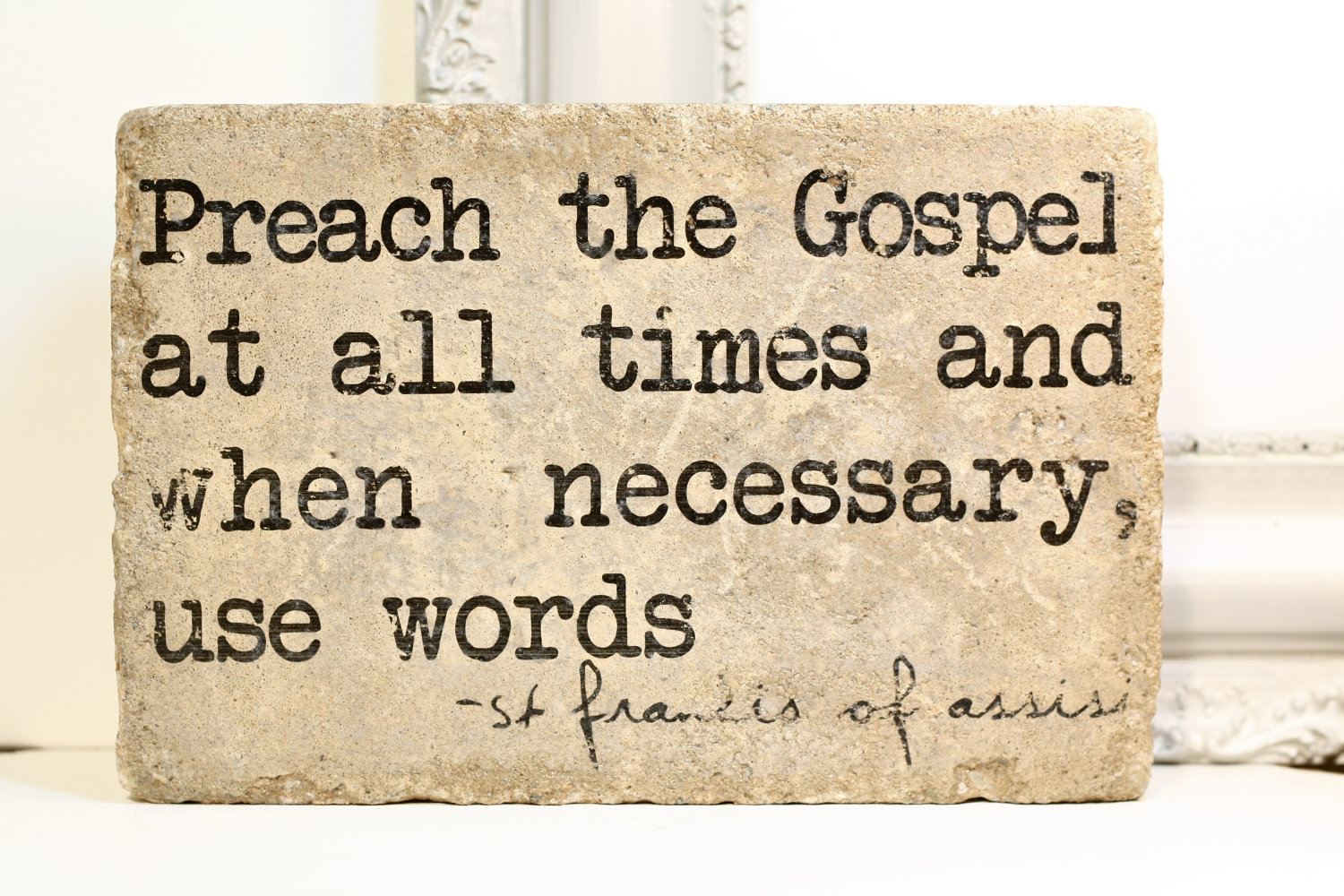
Now, there's nothing wrong with this quote. It's a very good quote, but as I've said before (perhaps not on this site) what's the difference, outwardly, between a Christian and a really good, moral person?
See, we live in a society of very good, moral people who believe that they just need to be good enough and God or the "great, mysterious, benevolent power/s that be" will let them pass into paradise. Christianity has been maligned and rubbed into the dirt through tabloid-esque fallings-out between pastors and churches, or pastors and their wives. Christianity is misportrayed as hypocritical or an impossibly high standard upon which everyone involved is then condemned for following it or failing in their attempt to do so.
Understandably, many Christians have fallen silent, rather than speak up and show the difference, but that's the whole point of this quote. Back to my first question, what is the outward difference between a Christian and a good, moral person?
Well, nothing.
The difference is inward. It's in the quality of difference, the consistency of difference. Te reason for the difference is, of course, that the BIG POINT of Christianity is that we're all screwed up, but are being changed from the inside. A moral person may or may not believe that man is screwed up, but the changes applied are external, because we, being screwed up, are incapable of changing ourselves. We need the work of an ultimately perfect God to perform the change. For St. Francis' quote to have any truth or merit, then,. one must already be walking around as a known Christian.
So, what prompted this change in perception about doing everything as unto God? Well, it was a simple conversation in whisperchat (in-game direct person-to-person chat instead of the common guild chat) in which one player who'd deemed me trustworthy began talking to me about life and struggles. The struggles just happened to be something that I couldn't explain the solution without God. I'd tried and the point didn't seem to be conveyed, so I broke my typical undercover Christian guise, outed myself and said the "G" word. It was then that I realised that it was possible to have a "redemptive purpose" for every different like and dislike. I can talk shop with my fellow scientists, musos, gamers, and guildies. I can build important relationships and model good, Christian living, but I can also use those relationships as vehicles for the Gospel. I can stand openly in my fields of interest as a Christian. I can share the Gospel without being cheesy. I can be attentive and listen to my fellows for what they need and, tactfully, tastefully, show them how God meets that need.
That, friends, is the merit of St. Francis' quote.
Sunday, May 25, 2014
A Systematic Exposition of Salvation
It has occurred to me that while I may speak of or reference different aspects of salvation, I have not actually put to writing a systematic discourse on my beliefs and reasonings relating to salvation. Therefore, this post has been written. Take from it what you will. If you are here to deride, scorn or belittle, I bid you good day. If you are here out of curiosity or a search for understanding, welcome!
At the beginning is God, omnipotent, omnipresent, omniscient, and omnibenevolent, who, merely with his speech, brought forth into existence time and space, giving everything form and functon for the express purpose of displaying His attributes, an action which, in any other being would be blasphemous and arrogant, but, as God is the supreme being, there is none higher for Him to give service to, making it, therefore, reasonable for God to act towards his glory, spurring the creation of time, space, the details, and man, the pinnacle of His creation, who was imbued with the ability to glorify God in the freest, fullest of manners: by free will, a gift which, at the moment of testing, was used to choose disobedience over obedience, marring the perfection of God's creation, separating mankind from God, because God, being infinitely perfect, righteous, and holy, cannot, by His nature, bear the presence of our then newfound imperfection, but instead, acting out of time, ended the scourge of disobedience at a set point in time foreknown to give Him the most glory, while, acting out of mercy, love, and grace for His creation, inside the flow of time, providing a temporary means of expiation of this disobedience, this imperfection, this sin, through the lifeblood sacrifice of a pure, unblemished animal, setting the stage for the future, permanent atonement for the fallenness of His creation, which occurred through the sending of Jesus, the son of God, who, being fully God, yet fully man was able to identify with and understand the burdens and cares of man, yet was able to live a life pure and without sin, providing a lifeblood sacrifice in accordance with the law set in time previously, the difference being that Jesus, being fully God, is not temporal, is not finite, but, rather, is infinite, able to atone for the sins of humanity past, present, and future and, after his death, was buried, but, three days later, He was returned to life, thereby breaking the necessary consequence of sin, that is, death, as the final part of His sacrifice such that whosoever accepts this sacrifice has his or her sins paid for by the sacrifice of Jesus such that under the eyes of God, it is as if he/she has never sinned, allowing him/her to be rejoined in communion and relationship with God.
Thus ends my expounding of the justifying action of salvation in one sentence.
At the beginning is God, omnipotent, omnipresent, omniscient, and omnibenevolent, who, merely with his speech, brought forth into existence time and space, giving everything form and functon for the express purpose of displaying His attributes, an action which, in any other being would be blasphemous and arrogant, but, as God is the supreme being, there is none higher for Him to give service to, making it, therefore, reasonable for God to act towards his glory, spurring the creation of time, space, the details, and man, the pinnacle of His creation, who was imbued with the ability to glorify God in the freest, fullest of manners: by free will, a gift which, at the moment of testing, was used to choose disobedience over obedience, marring the perfection of God's creation, separating mankind from God, because God, being infinitely perfect, righteous, and holy, cannot, by His nature, bear the presence of our then newfound imperfection, but instead, acting out of time, ended the scourge of disobedience at a set point in time foreknown to give Him the most glory, while, acting out of mercy, love, and grace for His creation, inside the flow of time, providing a temporary means of expiation of this disobedience, this imperfection, this sin, through the lifeblood sacrifice of a pure, unblemished animal, setting the stage for the future, permanent atonement for the fallenness of His creation, which occurred through the sending of Jesus, the son of God, who, being fully God, yet fully man was able to identify with and understand the burdens and cares of man, yet was able to live a life pure and without sin, providing a lifeblood sacrifice in accordance with the law set in time previously, the difference being that Jesus, being fully God, is not temporal, is not finite, but, rather, is infinite, able to atone for the sins of humanity past, present, and future and, after his death, was buried, but, three days later, He was returned to life, thereby breaking the necessary consequence of sin, that is, death, as the final part of His sacrifice such that whosoever accepts this sacrifice has his or her sins paid for by the sacrifice of Jesus such that under the eyes of God, it is as if he/she has never sinned, allowing him/her to be rejoined in communion and relationship with God.
Thus ends my expounding of the justifying action of salvation in one sentence.
Tuesday, September 24, 2013
Under Fire
It might come as no surprise to you that there exist countries in which the Gospel is banned. In some of these, an exposed missionary might get off with as little as deportation. In others, jail, torture, or death. Yet despite the opposition, Christian men and women answer God's call to put their lives on the line so that others might hear of the salvation of God.
To most of the world, this would seem mad and, to a degree, they'd be right. What people don't seem to understand is two things:
Sometimes we have this perspective of missionaries as honourable radicals and the rest of us as wise men, assimilating into society, staying below the radar so we aren't persecuted, Kind of like these guys:
So, yes, you can run, hide, and you might live. You can step out into the fight and stand bold for Christ and you may die, but at the end of the day, at the final judgment, will you be separated into the sheep or the goats?
To most of the world, this would seem mad and, to a degree, they'd be right. What people don't seem to understand is two things:
- The Great Commission. The directive to go and make disciples worldwide (whether at home or away) was never a suggestion. It was never an option. It was and is a command and if one is living under and following after Christ, this is a non-negotiable, not from a legalistic standpoint, but from the desire to honor God.
- Death is not the end. As Paul put it, "to live is Christ and to die is gain." If we live, we continue to serve Christ and to bring Him glory. If we die, we are present with Him in glory - something far better than this world can ever give.
We are called to stand up in the face of opposition and make disciples. We are told to grow in our faith and relationship with Christ so that, when asked, we may give a reasoned defense. We are told to seek God and His glory above all else and God will give us the strength to accomplish the tasks set before us.
We will face trials. We will face persecution. We were never promised the "Christian Dream" of a good job, beautiful wife, lovely family, no troubles, etc. Christ flat out tells his followers in the begging that we're going to have crap thrown our way because we follow Him.
“If the world hates you, understand that it hated Me before it hated you. If you were of the world, the world would love you as its own. However, because you are not of the world, but I have chosen you out of it, the world hates you. Remember the word I spoke to you: ‘A slave is not greater than his master.’ If they persecuted Me, they will also persecute you. If they kept My word,they will also keep yours. But they will do all these things to you on account of My name, because they don’t know the One who sent Me. If I had not come and spoken to them, they would not have sin. Now they have no excuse for their sin. The one who hates Me also hates My Father. If I had not done the works among them that no one else has done, they would not have sin. Now they have seen and hated both Me and My Father. But this happened so that the statement written in their scripture might be fulfilled: They hated Me for no reason." - John 15:18-25So, stand up. Pray for and support those on the front lines, whether they be in Syria, China, Indonesia, or Alabama. Step up to the plate and further the Gospel in your city.
Sometimes we have this perspective of missionaries as honourable radicals and the rest of us as wise men, assimilating into society, staying below the radar so we aren't persecuted, Kind of like these guys:
So, yes, you can run, hide, and you might live. You can step out into the fight and stand bold for Christ and you may die, but at the end of the day, at the final judgment, will you be separated into the sheep or the goats?
Tuesday, February 19, 2013
Difficult Battlefields
I had an encouraging conversation with a friend today. What made it encouraging? Well, we were conversing about ministry in the future.
You see, he's a Pastoral Leadership student from an affluent, upper-class background who wants to minister specifically to upper-class individuals in "post-Christian" nations.
You can stop staring at the screen like I'm crazy.
"But isn't he supposed to forsake all riches and go dig sewage ditches in India for Jesus?"
Only if God calls him to, which, as much as was apparent, He hadn't.
Now, as for why I'm encouraged: compared to reaching affluent individuals, particularly of my generation, in developed countries, evangelizing to the poor, impoverished, and malnourished is almost like comparing a multiplication quiz to integral calculus.
Now, I'm not saying we shouldn't minister to the poor, because we should. We're called to do so as Christians. What I'm saying is that it's a completely different ballgame and here are a few reasons why:
You see, he's a Pastoral Leadership student from an affluent, upper-class background who wants to minister specifically to upper-class individuals in "post-Christian" nations.
You can stop staring at the screen like I'm crazy.
"But isn't he supposed to forsake all riches and go dig sewage ditches in India for Jesus?"
Only if God calls him to, which, as much as was apparent, He hadn't.
Now, as for why I'm encouraged: compared to reaching affluent individuals, particularly of my generation, in developed countries, evangelizing to the poor, impoverished, and malnourished is almost like comparing a multiplication quiz to integral calculus.
Now, I'm not saying we shouldn't minister to the poor, because we should. We're called to do so as Christians. What I'm saying is that it's a completely different ballgame and here are a few reasons why:
- The needs to be met are often not physical and not apparent, hidden by many layers
- You need to discern and address the individual's philosophy
- You need to be able to think on your feet - there are many stock arguments used to tie up Christians in logical fallacies
- You need to be able to refute the most recent pop philosophy, atheist argument, or evolutionary discovery
- You need to be able to stand your own in both a formal and an informal debate
- You need to be able to conduct yourself and converse at the appropriate level (the upper crust can be very particular about its ways, many of which don't quite fit with Christianity, but anyone trying to spread the Gospel must be aware of and fluent in these nuances)
- Having successfully shown yourself as a well-educated member of society, you may have been allowed a step closer into confidence - don't mess up now.
- Is there any resistance to religion/Christianity? Subtly address it without religious arguments
Finally, after going through all of these hoops, and more, after having refuted and addressed their intellectual strongholds and beliefs, once you have cleared away the dross, then you may begin to use the Bible.
As you can see, it takes a very unique individual to reach the higher strata of society, strata which are comprising a larger and larger percentage of the Western world while becoming more and more areligious.
So, yes, I'm encouraged. I'm encouraged because I see that God has called and equipped him to a difficult battlefield, a battlefield more mental than physical.
Thursday, January 31, 2013
My Conversion Story
So, I had to write this up for my Theology class (It was due this morning) and I figured, "Why not publish it to the world at large?"
"Looking back, the last 14 years have been largely impacted by a single event. Had this event not happened or merely happened at a later date, I would be a very different person with unknowable different experiences. This event, of course, was my decision to accept Jesus as the payment for my sin and my lord.
The details, some 14 years old, are somewhat hazy, but I remember having grown up a pastor's kid at a decently-sized country church outside of Richmond, VA. I knew all the Sunday School stories and answers, but, increasingly, I was becoming aware that there was something more than a picture Bible and itchy sweaters.
All of this culminated during the summer of '98. I remember going to our church's VBS, being excited because of the space theme and looking forward to Mrs. Pope's desserts. little was I to know that on that day, my teacher would hit the nail on the head. She was teaching on Jesus' Sacrifice & payment for our sins - the culmination of the week's lessons. To this day I do not know what moved me to mark the back of the card, but I have a fairly good guess it was the Holy Spirit.
A few days later, my dad, having been told by my teacher, sat me down and explained in detail what it meant to be a Christian. Not long after that, I remember praying through the ABC's of salvation in an earnest 8-year-old's prayer, acknowledging my sin, committing my life to Christ, and knowing full well what that meant."
Wednesday, December 26, 2012
Post-Christmas Lesson
When I was younger, I used to watch Sesame Street.
Let me rephrase that.
When I was younger, I wanted to live on Sesame Street.
I watched that show multiple times a day, almost every day; I never got tired of it. One reason I loved it was the songs. I remember one in particular song around this time of year (well, two, but, for the sake of this post, one) from one of the Christmas Specials (I can't remember which one, but I'm pretty sure it's not Big Bird Searches for Santa):
Now, I know the song is talking about saving the love, joy, and general "Christmas-y" concepts to enjoy throughout the year, but I cannot help but draw all of this back to God.
You see, Christmas is truly about love, joy, peace, hope, etc., but the reason for that is not because of the people, the gifts, or even the "Christmas Spirit". The reason for Christmas and all its associated marvels lies in its name - Christ.
Christ, or Messiah in Hebrew, is a title meaning "Anointed One".
Okay, well, what does that mean?
In Jewish society (the Jews were the ones awaiting the Messiah, after all), anointing was a physical demonstration of the appointing of one by God to a specific calling, notably the high priest, prophet, or king.
So, we have this Anointed One, Jesus, who is appointed by God for a specific task - namely the rescue and redemption of mankind from sin to God. Which means that He had to have been free from sin as well. (Think about it: can one mired in sin rescue all others from their sin? No, only one who is already free from sin can bring others to freedom.) Because mankind is inherently sinful (thank Adam and Eve for that), to be born free from sin, the Messiah must have been conceived sinlessly, i.e. from the seed of a sinless being - God.
Enter the "Immaculate Conception". As was prophesied (Isaiah 7:14), God begat a child with a virgin woman, Mary. Why a virgin? Two reasons: 1) To prevent any doubt as to whether the child was really the son of God and 2) to be miraculous - normally, to conceive, a virgin must lose her virginity; therefore conception without a loss of virginity is miraculous. (no, IVF hadn't been devised and I'm pretty sure that would constitute a loss of virginity anyways)
So, we have a sinless Anointed One, born of a virgin, who is supposed to free mankind from sin, which is separation from God. God is holy, perfect, and just. As such, God cannot stand sin as it is less than perfection and neither can he ignore it as to do so would not be perfectly just. So, to save mankind from sin, someone had to pay the punishment and the only one able to pay the punishment for another is one who has not committed the crime. (otherwise he's merely doing his own punishment) It is for this reason, redemption, that Jesus the Christ came into this world as a sinless, Anointed One.
This is the message of Christmas. This message of God's love, redemption, and forgiveness and our subsequent peace, hope, and joy is the reason we celebrate Christmas. This is what we must keep with us, carrying it all through the year, reminding ourselves and telling others this very same message of the Anointed One, Christ Jesus.
Let me rephrase that.
When I was younger, I wanted to live on Sesame Street.
I watched that show multiple times a day, almost every day; I never got tired of it. One reason I loved it was the songs. I remember one in particular song around this time of year (well, two, but, for the sake of this post, one) from one of the Christmas Specials (I can't remember which one, but I'm pretty sure it's not Big Bird Searches for Santa):
"Keep Christmas with you| All through the year.| When Christmas is over| Save some Christmas cheer.| These precious moments,| Hold them very dear.| So keep Christmas with you| All through the year."Pretty profound for a kids' show.
Now, I know the song is talking about saving the love, joy, and general "Christmas-y" concepts to enjoy throughout the year, but I cannot help but draw all of this back to God.
You see, Christmas is truly about love, joy, peace, hope, etc., but the reason for that is not because of the people, the gifts, or even the "Christmas Spirit". The reason for Christmas and all its associated marvels lies in its name - Christ.
Christ, or Messiah in Hebrew, is a title meaning "Anointed One".
Okay, well, what does that mean?
In Jewish society (the Jews were the ones awaiting the Messiah, after all), anointing was a physical demonstration of the appointing of one by God to a specific calling, notably the high priest, prophet, or king.
So, we have this Anointed One, Jesus, who is appointed by God for a specific task - namely the rescue and redemption of mankind from sin to God. Which means that He had to have been free from sin as well. (Think about it: can one mired in sin rescue all others from their sin? No, only one who is already free from sin can bring others to freedom.) Because mankind is inherently sinful (thank Adam and Eve for that), to be born free from sin, the Messiah must have been conceived sinlessly, i.e. from the seed of a sinless being - God.
Enter the "Immaculate Conception". As was prophesied (Isaiah 7:14), God begat a child with a virgin woman, Mary. Why a virgin? Two reasons: 1) To prevent any doubt as to whether the child was really the son of God and 2) to be miraculous - normally, to conceive, a virgin must lose her virginity; therefore conception without a loss of virginity is miraculous. (no, IVF hadn't been devised and I'm pretty sure that would constitute a loss of virginity anyways)
So, we have a sinless Anointed One, born of a virgin, who is supposed to free mankind from sin, which is separation from God. God is holy, perfect, and just. As such, God cannot stand sin as it is less than perfection and neither can he ignore it as to do so would not be perfectly just. So, to save mankind from sin, someone had to pay the punishment and the only one able to pay the punishment for another is one who has not committed the crime. (otherwise he's merely doing his own punishment) It is for this reason, redemption, that Jesus the Christ came into this world as a sinless, Anointed One.
"For God so loved the world that He gave His only begotten Son so that whosoever believes in Him might not perish, but have eternal life" - John 3:16Oh, I forgot to mention, the punishment for sin: death, and by death I mean a final, total, spiritual death following one's corporeal death, while the end of those redeemed by Christ is life eternally in the presence of God.
This is the message of Christmas. This message of God's love, redemption, and forgiveness and our subsequent peace, hope, and joy is the reason we celebrate Christmas. This is what we must keep with us, carrying it all through the year, reminding ourselves and telling others this very same message of the Anointed One, Christ Jesus.
Sunday, December 23, 2012
Seeking the King
So, with my family in the US and all, my dad, of course has done and will be doing some speaking engagements. Today was one such day. One thing he said (which was also touched upon by the Sunday School teacher) struck a bit of a chord.
Looking at the magi which traveled to honour the (at the time) newborn Messiah (Matt 2:1-12), he illustrated, amongst other ideas, the dedication and drive possessed by the magi to finding this newborn king.
These men saw a star, traveled for ~2 years, found that their initial idea of the child's location was wrong, found correct information and went to the child. They brought with them gifts; some might say they were symbolic, but all will agree they were expensive gifts, gifts deemed the best to give to honour the now-come Messiah.
Conversely, the Jews in Herod's court (and Herod himself) knew about the coming arrival of the Messiah and where He would be born. They were a very short distance away from Him, yet when they heard that He was born, they couldn't be bothered to take a measly day's travel to seek Him out.
The question my dad asked [well, either that or implied] which caught my ear, and I hope it catches yours, was "What is your reaction to the newborn King?" Is it "I must follow after and seek out the King" or merely "Meh"?
Looking at the magi which traveled to honour the (at the time) newborn Messiah (Matt 2:1-12), he illustrated, amongst other ideas, the dedication and drive possessed by the magi to finding this newborn king.
These men saw a star, traveled for ~2 years, found that their initial idea of the child's location was wrong, found correct information and went to the child. They brought with them gifts; some might say they were symbolic, but all will agree they were expensive gifts, gifts deemed the best to give to honour the now-come Messiah.
Conversely, the Jews in Herod's court (and Herod himself) knew about the coming arrival of the Messiah and where He would be born. They were a very short distance away from Him, yet when they heard that He was born, they couldn't be bothered to take a measly day's travel to seek Him out.
The question my dad asked [well, either that or implied] which caught my ear, and I hope it catches yours, was "What is your reaction to the newborn King?" Is it "I must follow after and seek out the King" or merely "Meh"?
Ooh, and add to that the shepherds' reaction - they were rejoicing and ecstatic about the birth of the Messiah, while, once again, the Jewish advisers and scholars reacted indifferently, a distinction of "THE MESSIAH IS BORN! WE MUST GO AND SEE; TELL THE OTHERS!" versus "The Messiah? He's supposed to be over there."
So, I ask myself as I ask you, the reader, "What is your reaction to Jesus Christ, the Messiah, the saviour of the world?"
Sunday, February 26, 2012
GO! (or, let me ask you a question)
I was talking with a friend earlier tonight about the church. We talked about many things ranging from complacency to 1st world/3rd world differences to "Country Club" church culture in the Western world. One big sticking point to which we kept returning was the idea of complacency and what we should be doing.
Regarding complacency, we talked, talked, and talked some more and we came to the point of realizing that we couldn't peg down what was the key cause of complacency. We tossed up Western culture, status as a Christian nation, wealth, comfort, and a multitude of other options. We also couldn't figure out why some individuals dedicate so much time to the church, learning, growing, and serving, yet they rarely talk of Christ or Christianity outside of church and then usually only in the context of their church.
Let me ask you a question. In a legal setting, if someone knows critical information about a case under investigation/trial, but refuses to divulge this, what happens to the person?
Now, let me ask you another question. If you knew a specific person was going to die today, would you tell them and try to avert their death? On whose head would the blame lie if you don't tell and the individual dies?
Let me bring to your attention the words of God:
"What warning?"
Why, the warning that every man is born sinful and destined for eternal death and hell. Yes. I just said hell. It's a real place and it's where anyone who hasn't accepted Christ as their lord and their saviour is destined to go.
Let me ask you yet another question, or rather, let me allow Penn Jillette, who, at the time of this clip, was not a Christian (I don't know if he currently is one) to ask the question.
It's a direct command from Christ.
Penny for your thoughts?
For more information about missions, evangelism, and unreached people groups worldwide, check out these sites:
Regarding complacency, we talked, talked, and talked some more and we came to the point of realizing that we couldn't peg down what was the key cause of complacency. We tossed up Western culture, status as a Christian nation, wealth, comfort, and a multitude of other options. We also couldn't figure out why some individuals dedicate so much time to the church, learning, growing, and serving, yet they rarely talk of Christ or Christianity outside of church and then usually only in the context of their church.
Let me ask you a question. In a legal setting, if someone knows critical information about a case under investigation/trial, but refuses to divulge this, what happens to the person?
Now, let me ask you another question. If you knew a specific person was going to die today, would you tell them and try to avert their death? On whose head would the blame lie if you don't tell and the individual dies?
Let me bring to your attention the words of God:
"As for you, son of man, I have made you a watchman for the house of Israel. When you hear a word from My mouth, give them a warning from Me. If I say to the wicked, 'Wicked one, you will surely die,' but you do not speak out to warn him of his way, that person will die for his iniquity, yet I will hold you responsible for his blood." - Ezekiel 33:7-8Now, let me ask you a third question. Readers who associate with the Christian faith (i.e. you who call yourselves Christians), when last did you convey God's warning to the people around you?
"What warning?"
Why, the warning that every man is born sinful and destined for eternal death and hell. Yes. I just said hell. It's a real place and it's where anyone who hasn't accepted Christ as their lord and their saviour is destined to go.
Let me ask you yet another question, or rather, let me allow Penn Jillette, who, at the time of this clip, was not a Christian (I don't know if he currently is one) to ask the question.
"How much do you have to hate someone to not tell them about Jesus?""Okay, fine, but please tell me this, why should I go and tell some complete stranger?"
It's a direct command from Christ.
- Matthew 28:18-20
- Mark 16:15
- Luke 24:46-47
- John 21:20
- Acts 1:8
These are 5 different accounts of Christ's last words before His ascension. Nowhere in them is there the idea that this is an option. It is a direct command to preach the Gospel to the world. You don't have to go to some foreign country either. You can start right now at the 7-Eleven down the road.
"But evangelism isn't one of my spiritual gifts!"
Well, fortunately for you, evangelism isn't a spiritual gift. Romans 12 nor 1 Corinthians 12 speak of evangelism as a gift. It is an imperative action. It is something we must do.
"But I'm saved by grace, not by works."
Correct you are, but let's check out James 2:14-26. (verse 26 below)
". . . 26 For just as the body without the spirit is dead, so faith without works is dead"Evangelism, being a work stemming from one's faith, is an integral part to Christianity. Evangelism is the vehicle by which word of God is spread. Were it not for evangelism, Christianity would not have spread all throughout the Roman Empire in a few hundred years.
Penny for your thoughts?
For more information about missions, evangelism, and unreached people groups worldwide, check out these sites:
Subscribe to:
Posts (Atom)